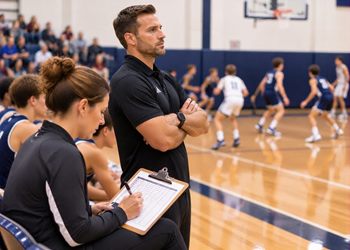
You walk out of Saturday's gym with a knot in your stomach and a dozen guesses in your head. You felt like your team threw the ball away too much, gave up easy putbacks, and rushed shots, yet when you sit down to plan a 60-to-90-minute practice on Monday, you still do not know where to start. Trying to track every box-score column on a clipboard yourself only pulls your eyes off the floor when your players need live coaching most.
You do not need expensive software or a full-time manager to keep basketball stats that matter. A free, printable BasketballXpert stat sheet and a handful of focused numbers give any youth coach clear answers for Monday's practice. With one parent volunteer or assistant running a simple tally system, you can coach the live game with calm confidence and leave with exact priorities for next week.
Pick the Four Stats That Actually Change Practice
Points on the scoreboard tell you who won, but they rarely tell you why a youth game slipped away. A team can score 32 points and still lose the possession battle because of unforced mistakes or second-chance points surrendered. Instead of chasing a full pro box score--which overwhelms a volunteer and hides the real story--track the four numbers that show where possessions are won or lost:
- Turnovers (split by cause): Separate unforced errors (telegraphed passes, travels, stepping out of bounds) from pressure turnovers (traps or steals forced by an aggressive defense). Unforced errors point to passing habits and ball security; pressure turnovers point to spacing and handling traps.
- Offensive vs. defensive rebounds: Look at how many possessions end with one shot versus two or three. As BasketballXpert contributor Shane notes in Defensive Rebounding Tips, "Blocking out is a basic of basketball rebounding. Keep inside position. Get into your man and do not let him have a clean effort on the ball. Many times you cannot get the rebound. In that case you must make sure your man cannot get it either." Most misses come off to the backside, and longer shots produce longer rebounds, so inside position matters more than jumping ability. On the other end, Becoming a Better Offensive Rebounder reminds us that offensive boards come down to desire, effort, and consistency--making a second or third strong move after a shot goes up.
- Shot quality (paint touches vs. contested perimeter shots): A missed layup after a strong drive is a good possession; a rushed, contested jumper three seconds into the clock is a wasted one. Counting paint touches alongside 2-point and 3-point attempts tells you whether your offense is creating high-percentage looks or settling.
- Free throws (or hustle deflections): In Ideas for Working on Free Throws, Shane points out that "Shooting well from the free throw line is the difference between winning and losing the tight games." Tracking free throw makes and attempts--or pairing that with hustle deflections if your league calls few fouls--shows whether your team finishes tough plays with composure.
BasketballXpert's free Printable Basketball Stats Sheet already tracks shot attempts and makes for 2-pointers, 3-pointers, and free throws, plus offensive and defensive rebounds, assists, steals, and blocks. Because that standard sheet does not include dedicated columns for turnovers, paint touches, or deflections, simply repurpose two unused columns or jot those tallies in the margin--keeping your focus on team possessions rather than individual scoring.
Set Up a Game-Day Stat Sheet Anyone Can Run
A stat system only works if it survives the speed of a live youth game. As Shane advises in Common Mistakes of a Basketball Coach, "Use practice to develop and fine tune your system. Let the kids execute the system in the games. Use stoppages and substitutions to adjust and correct problems." Handing the clipboard to a reliable helper lets you watch spacing, effort, and matchups while the numbers accumulate quietly on the bench.
Prep the Printable Sheet and Train a Helper in Three Minutes
Never ask a parent volunteer or injured player to figure out a stat sheet during the opening tip. Do the prep work before warmups so their job takes minimal judgment and zero complex shorthand:
- Pre-fill jersey numbers down the left column before you leave home or during pregame layups.
- Circle your 3 or 4 priority columns at the top of the Printable Basketball Stats Sheet (for example: rebounds, free throws, and two repurposed margin columns for turnovers and paint touches).
- Use the sheet's built-in circle-and-slash marks so your helper never has to write words. As BasketballXpert contributor Johncd explains on the stat sheet guide: "On shot attempts, circle the shot marker. If the shot is made, mark a slash (/) through it. When marking rebounds on the printable basketball stats sheet, mark offensive rebounds with a circle, and a slash (/) through a defensive rebound."
- Run a three-minute pregame briefing on exact definitions. Tell your helper: "A turnover is any time we lose the ball without getting a shot off; a paint touch is any catch or dribble inside the lane." Keeping definitions simple prevents second-guessing, even if an occasional borderline play gets missed.
Keep the Clipboard Off the Head Coach's Hands During Live Play
Once the ball goes up, leave the pen with your helper. Your eyes belong on the floor--watching whether your guards see the weak-side help, whether your posts seal early, and which players look rattled.
At halftime, run a 30-second stat check before you step into the huddle. Ask your helper for just two numbers--such as total turnovers and offensive rebounds allowed--and ignore the rest of the sheet until after the game.
In The Art of the Basketball Timeout, Shane writes, "Focus on one or two quick points and do not bombard the players with too many issues. One issue is the best and hammer your point home." Stay positive when you are behind instead of scrapping your plan. Say something clear and actionable: "We have nine turnovers, and six of them came from forcing passes into traffic. Second half, two-hand catch, chin the ball, and look opposite before you dribble."
Turn Weekend Numbers Into Monday's Practice Plan
On Sunday night, lay the stat sheet on the kitchen table and look for the single biggest possession leak. Do not try to fix turnovers, rebounding, free throws, and zone offense all in one 60-to-90-minute session.
Shane nails this rule in The Importance of Planning in Basketball Practices: "Have a goal or couple of goals for your practice. Choose to focus on areas that your team needs to improve upon and stay on topic. Do not do a dribbling drill followed by a shooting drill and then a defensive drill all in a row. Pick a topic and focus your session there."
Use a simple decision rule for the first 15 to 20 minutes of Monday's practice:
- High unforced turnovers: Start with ball-security passing and decision-making under light pressure, such as Basketball Offensive Drill - Swing passing, cut and finish at the rim, to sharpen quick, accurate perimeter passes and hard cuts.
- Too many second-chance rebounds allowed: Open with physical box-out habits using 1vs1 Close-Down/Box-Out, teaching players to get in a low, wide stance, move their opponent out of the flight of the ball, and explode to catch the rebound at its highest point.
- Low paint touches and rushed perimeter shots: Run a breakdown where every possession requires an interior touch or post feed before a perimeter shot goes up.
Remember what Shane emphasizes in Why do Basketball Practices Fail?: "Basketball practices fail to improve player's skills because there is the absence of a specific goal, immediate feedback and/or player concentration. Practice is about repetition and attacking a single goal." Give immediate feedback during that opening block so players feel the difference between a sloppy rep and a clean one, then check the same stat at the end of the week to see if the leak shrank.
Run a Live-Stat Practice Station Blueprint
Stats should not live only on Saturdays. Bringing a clipboard onto the practice floor turns abstract coaching cues into immediate, game-speed habits. You can run this 10-to-15-minute live-stat station using BasketballXpert's 4v4 Round Robin format (which works just as smoothly 3v3 if you have fewer than 12 players).
Court Setup & Rotation
- Space: Half-court (or two cross-court baskets if you have a large roster).
- Teams: Split your squad into 3 teams wearing different colored jerseys or pinnies.
- Rotation: Two teams play to 10 points (1 point for regular baskets, 2 points for 3-pointers) while the third team sits out on the baseline. Every defensive rebound or steal must be taken outside the 3-point line to become "hot" before the new offense can score. The losing team rotates off, and the resting team rotates on.
The Live-Stat Twist
Give the resting team--or an assistant coach--a clipboard to tally turnovers, defensive box-outs, and paint touches for the two teams on the floor. Calling out the tally during brief dead-ball resets connects game-speed decisions directly to the stat sheet.
Coaching Cues to Call Live
- "Chin the rebound!" -- Secure the board with two hands under the chin before looking to outlet.
- "Two-hand catch!" -- Meet the pass with two hands and a strong base to cut down unforced turnovers.
- "Paint before perimeter!" -- Touch the lane with a pass or drive before settling for an outside shot.
While the standard 4v4 Round Robin format simply plays to 10, adding a quick verbal stat recap after each rotation keeps the resting group engaged and reinforces the exact habit you pulled from Saturday's sheet.
Share Stats With Players Without Hurting Confidence
Numbers can either build calm accountability or make a 10-year-old afraid to shoot. How you frame the stat sheet matters just as much as what you write on it. As Shane warns in Common Mistakes of a Basketball Coach, "Yelling and screaming does nothing but rattle the kids and lead to more mistakes. Do you think they don't know when they mess up? Of course they do." Yanking a player immediately after one turnover only teaches them to play scared.
Keep individual shooting percentages and high-turnover totals for brief, private 1-on-1 check-ins, never public callouts in front of the team or parents. In the team huddle, celebrate controllable effort metrics--total defensive box-outs, hustle deflections, or team assist-to-turnover ratio--so every player sees how they can help the team win even when shots are not falling.
In Improving your mental toughness and focus, Shane urges players to "Compete against your own personal best every time out, and try to achieve that." Set controllable weekly goals with your players, such as "Let's beat last week's team box-out total" or "Can you cut your unforced passes in half this Saturday?" As Teaching Sportsmanship in Youth Basketball reminds us, youth coaching is about more than basketball--it is about setting the standard for respect toward referees, scorekeepers, opponents, and your own players.
You do not need pro analytics or extra staff to coach with clarity. Print the free Printable Basketball Stats Sheet on BasketballXpert, circle four possession-changing numbers, and hand the clipboard to a helper before tip-off--so you can coach the live game and walk into Monday's practice knowing exactly what to fix.