You know the feeling on Saturday morning: one guard dribbles into a crowd at the elbow while four teammates stand flat-footed on the perimeter, watching. You yell "Move!" from the sideline, someone takes two half-hearted steps, and the possession ends in a forced shot or a turnover. Complex set plays take weeks to memorize and fall apart on the first tipped pass.
You do not need a 12-play binder to fix standing around. You can teach a simple, positionless 5-out pass-and-cut offense in one practice using two rules every player can remember--pass and cut, then fill the open spot--backed by a 20-minute whole-part-whole practice plan. A skill sticks when practice looks like the game: play first, isolate one breakdown, then go right back to live basketball so your team moves together with purpose.
Why 5-Out Pass and Cut Works for Youth Teams
Memorized plays tell kids where to stand; a two-rule motion offense teaches them how to play. When all five players start outside the arc, the paint opens up for driving lanes and basket cuts instead of turning into a traffic jam. Every player touches the ball, and nobody gets stuck as a decoy in the corner all season.
As Why Beginning Coaches Should Focus on the Basics points out, dribbling too much around the perimeter is one of the most common faults in youth basketball. The defense adjusts with every bounce and turnover odds climb, whereas a defender cannot outrun a pass. As BasketballXpert contributor Shane puts it:
"The fastest way to attack in basketball is with the pass. Why do coaches allow players to dribble when they can pass so much faster?"
In games, watch for one quick visual red flag: three or more players standing inside the three-point arc or staring at the ball. Even a 5-out offense will stall if your passers hold the ball or cutters jog, so spacing alone is not magic--it simply gives your players room to sprint and a clear rule for what to do next. Using fewer players or more open space, like in 4v4 Round Robin, lets kids attack the rim creatively instead of crowding the lane.
The Five Spots and Two Rules Every Player Needs
For beginner youth teams, keep the game simple at first--teach from one basic plan and add options only after players master the core habits (Why Beginning Coaches Should Focus on the Basics). Instead of teaching five different positions, teach five spots and two rules.
Set the Five Perimeter Spots
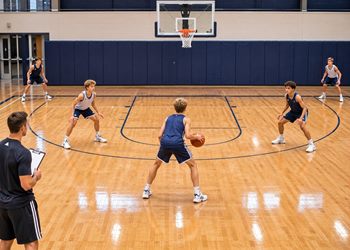
Before anyone cuts, your team has to see the floor geometry. Set five spots around the perimeter: one at the top of the key, two on the wings (free-throw line extended), and two in the deep corners.
- Use a clear floor line: If your players are young and cannot shoot from the high school three-point arc, tape or cone a spacing line two steps inside the arc--just keep everyone out of the lane.
- Give the verbal cue: "Feet behind the line, eyes on the rim."
- What to watch for: Players creeping two or three steps inside the arc as the ball moves, which shrinks their own cutting lanes and lets one defender guard two kids at once.
Rule 1 and Rule 2: Pass and Cut, Then Fill
Once your five spots are set, the entire offense runs on two rules:
- Pass and cut: The moment a player passes, they sprint straight toward the basket with their inside hand up as a target, looking for a return pass for a layup.
- Fill the open spot: If the return pass is not there, the cutter clears all the way out to an open perimeter spot (usually the opposite corner), while perimeter teammates rotate up one spot toward the ball to fill the gap.
Give them one three-word cue to chant in practice: "Pass, cut, fill." If a player passes and stands still to admire their throw--or jogs through the lane at half speed--blow the whistle right away and ask, "Where did you go after you passed?"
To build that habit before you even play 5v5, run the Five Point Passing Drill. Each passer follows their pass to take the receiver's spot, forcing players to think one step ahead, deliver crisp passes, and move immediately after the ball leaves their hands.
Whole-Part-Whole Practice Blueprint: 20-Minute 5-Out Progression
Drills only produce major skill improvement when players know the exact goal and get immediate feedback so they can feel the difference between a good rep and a sloppy one (Why do Basketball Practices Fail?). As Shane notes on BasketballXpert:
"Good coaches do not rely on just the drills to do the teaching; they instruct and offer feedback to the players."
Because a skill sticks when practice looks like the game, use this 20-minute Whole-Part-Whole blueprint at your next practice--play first, fix one habit, then play live again.
1. Whole: 5 Minutes of Half-Court Play
- Setup: Split into 4v4 or 5v5 in the half court, checking every possession outside the three-point line (modeled after 4v4 Round Robin, which normally runs 10-15 minutes for 4-12 players).
- Goal: Play live without stopping for plays. Watch where spacing breaks down--usually right after the first or second pass when players freeze.
- Coach's note: Do not lecture for five minutes. Point out one thing you saw ("We passed and watched--let's fix that") and move straight to the breakdown.
2. Part: 8 Minutes of 5-Spot Pass-Cut-Fill Breakdown
- Setup: Place five offensive players at the top, wings, and corners with cones marking the spots (under 3 minutes to set up, adapted from Basketball Offensive Drill - Swing passing, cut and finish at the rim, a 10-15 minute drill for 4-12 players that pairs accurate arc passing with hard basket cuts and decoy cuts). Start on air, then add dummy defenders at 50% speed.
- Rotation & Rep Target: Pass, sprint a basket cut, finish a layup or clear out while teammates fill up. Aim for 10-12 clean reps per group, rotating spots after each cut so every player practices cutting from the top, wing, and corner.
- Verbal Cues: "See the rim on your cut" and "Move on the air of the pass."
3. Whole: 7 Minutes of Live Scrimmage With a Cut Bonus
- Setup: Return to live 4v4 or 5v5 half-court play.
- Constraint: Keep normal scoring, but award 1 bonus point for any basket scored directly off a basket cut (whether the layup goes in or draws a shooting foul).
- Why it works: Players stop settling for contested perimeter dribbles and start hunting backdoor and face-cut layups on their own.
Common Game-Day Breakdowns and How to Fix Them
On Saturday, resist the urge to micromanage every pass from the bench. As Shane advises in Common Mistakes of a Basketball Coach:
"Use practice to develop and fine tune your system. Let the kids execute the system in the games. Use stoppages and substitutions to adjust and correct problems."
When the offense stalls in a game or scrimmage, use these three quick fixes during timeouts or practice stoppages:
- Cutters stopping in the lane: If a cutter does not get the ball and parks near the block, they clog driving lanes for everyone else. Sideline cue: "Cut all the way through to the opposite corner."
- Perimeter players standing still: When the top passes to the wing and cuts, the weak-side wing and corner must rotate up right away. Sideline cue: "Step up as soon as the ball leaves your teammate's hands."
- Passers holding the ball too long: Youth players often stare at a cutter for three seconds until the window closes, then force a pass into traffic. Teach a 2-second decision rule: catch in triple threat, pivot to see the cutter's target hand, and either hit the cutter, swing it, or attack. To train that poise against real pressure, progress from no defense to 50% to 100% live defense using Fake Shot or Fake Pass and Take to the Hoop so players learn to sell a pass fake and read the defender.
Simple Additions Once Your Team Masters the Basics
Do not add a second layer until your players automatically pass, cut, and fill without you yelling from the bench. Once that habit sticks, add one simple read: the dribble-at basket cut. When a ball handler dribbles directly toward a teammate on the wing instead of passing, that wing player does not stand there and bring two defenders together--they backdoor cut hard to the rim, and the rest of the floor fills behind the dribble.
One read keeps the offense sharp without turning it into a complicated playbook. Before next week's practice, download and print a copy of BasketballXpert's free Printable Basketball Court for your coaching binder so you can sketch the five spots, track your 20-minute Whole-Part-Whole plan, and draw quick cut reminders during timeouts.
When practice looks like the game--play, isolate one breakdown, and go back to live basketball--your team stops standing around one dribbler and starts playing together with confidence.