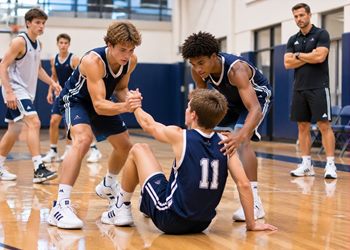
Most coaches cover sportsmanship in a five-minute preseason speech, then wonder why it vanishes the first time a referee misses a travel or a guard throws the ball into the third row. When the game speeds up and frustration hits, kids do not remember a lecture from three weeks ago. They fall back on the habits they have actually practiced under pressure.
You do not have to choose between being a demanding, competitive coach and running a respectful gym. A skill sticks when practice looks like the game. When you teach whole-part-whole--let players play, isolate one breakdown with a short cue, and go right back to live basketball--you build grounded confidence that your team can handle heated moments without losing its edge.
Why Preseason Lectures Fail and Game-Speed Habits Stick
Preseason speeches fail because they happen at zero miles per hour, with no scoreboard, no whistle, and no fatigue. In a real game, sportsmanship breaks down in predictable spots: eye-rolling at officials, blaming teammates after a turnover, or pouting on the bench after a sub. Treating those moments as skill breakdowns instead of character flaws changes how you coach them.
Poor sportsmanship in youth basketball often starts with the tone on the bench, as noted in Teaching Sportsmanship in Youth Basketball. When you model respect and address improper behavior firmly right away, players and parents learn where the line is. As the BasketballXpert Coaching Team puts it, "It only takes a firm hand once or twice and then your players and parents know improper behavior will not be tolerated."
That firm boundary sets the standard, though it will not rewire a player's habits overnight if practice never tests their composure. Players learn by playing through mistakes rather than getting yelled at or yanked off the floor, a core principle in Common Mistakes of a Basketball Coach. Use whole-part-whole in practice to train it live:
- Whole: Run a competitive small-sided game where contact, missed shots, and tight scores happen naturally.
- Part: Freeze play the second you see an eye-roll or finger-point, give one short behavioral cue, and reset the rep.
- Whole: Put the ball right back in play so your players feel what composure looks like at game speed.
Three Observable Habits to Teach in Every Gym
"Be a good sport" means nothing to an eleven-year-old when they are down four points with two minutes left. Replace vague reminders with concrete, observable actions your players can execute on the floor and on the bench.
Start with the bookends of every game. Teaching Sportsmanship in Youth Basketball recommends simple routines like having players shake opponents' hands before tipoff and officials' hands after the final buzzer, win or lose. Those bookends matter, though they only hold up if your players practice how to respond between the opening tip and the final horn.
Teammate Response: Help Up, Next Play, and Bench Energy
When a player turns the ball over or hits the floor, their next three seconds determine whether your team stays connected or fractures. Yelling after a mistake only rattles players and triggers more errors, according to Common Mistakes of a Basketball Coach. Coach Shane summarizes the standard clearly: "The way player learn is to play through mistakes. Problem solving and handling adversity are missing in todays game."
Teach three visible habits your players can run on autopilot:
- Sprint to help up: Whenever a teammate hits the floor, the two nearest players sprint over to pull them up before walking back to the huddle or free-throw lane.
- Call "next play": After any turnover or missed shot, players clap once and use the two-word cue "next play" instead of dropping their heads or pointing fingers.
- Stand and clap on the bench: Reserves stay engaged, stand to clap for hustle plays, and greet subbed-out teammates with a high five.
From the sideline, match their energy with short, positive cues--"Eyes up, next play!" or "Go get your teammate!"--and save deeper teaching for stoppages. Positive cues will not stop every frustrated groan in the moment, especially with younger players still learning emotional control, but they keep one bad possession from turning into three.
Handling Calls and Competing With Respect
Tough whistles and physical defense are where good teams separate themselves. Give your players a simple mechanical routine so their hands and mouths do not get them in trouble before their brains catch up:
- "Hands up, eyes on coach": The instant a foul whistle blows, the defender raises both hands straight up, turns away from the official, and looks to the bench.
- Ball to the ref: After a dead ball or out-of-bounds call, the nearest player hands or bounces the ball directly to the official instead of kicking it or flipping it away.
- Compete without chatter: Play hard through contact, box out on every shot, and save all talk for defensive communication.
Your own sideline demeanor sets the ceiling for how your players handle adversity. Teaching Sportsmanship in Youth Basketball puts it directly: "We as basketball coaches need to display respect for all involved...meaning referees, scorekeepers, opposing players and coaches." Modeling composure will not guarantee every call goes your way, yet it removes your players' excuse to argue when calls are tight.
A Ready-to-Run Practice Blueprint for Composure Under Pressure
If you only have 15 minutes of gym time left, use it to create game-like frustration on purpose and reward composure in real time. The 4v4 Round Robin - Basketball Drill is built for this: it keeps scores tight, rotates teams quickly, and forces players to manage calls and mistakes without a referee standing over every play.
Setup and Rotation (10-15 minutes):
- Court spots: Half court with 12 players split into 3 teams of 4 in different colors (run 3v3 if you have fewer than 12).
- Game flow: Two teams play to 10 points (1 point per basket, 2 for a 3-pointer, no free throws; check the ball outside the 3-point line to become "hot"). The third team sits on the baseline and rotates in against the winner.
- Composure scoring rule: Award 1 bonus point the first time a team sprints for a "help up" or hands the ball cleanly after a call, and take 1 point away if a player argues a call or blames a teammate.
- Coaching cues: Keep your voice short--"Help up!", "Next play!", and "Ball to the ref!"--and step in only to isolate a breakdown before restarting play.
To target specific pressure points in smaller groups, swap in one of these options:
- Foul discipline and contact: Run the 1v1 basketball game for 10-15 minutes with 4-12 players. Line players up at mid-court with the first defender near the free-throw line; each offensive player gets 2 possessions to score before rotating to defense, and fouling a shooter gives the offense an automatic point (2 fouls in 2 possessions also equals a point).
- Missed-shot frustration: For younger groups or shooting-focused days, run Two Bounce 21 - Basketball Shooting Game (2-3 players per hoop, 10-15 minutes, first to 21) to create instant pressure around missed shots and free throws.
None of these games fix bad habits in a single night, so slot one into your weekly practice plan where players expect to compete.
Game-Day Corrections: What to Say in Timeouts and Lopsided Games
Game day tests your composure in two opposite ways: a tight game where a player boils over, and a lopsided score where respect can slip on either side. In both spots, your job is to make calm, targeted adjustments rather than lecturing the huddle.
When a player loses their cool in a tight game, use a substitution or timeout for a calm bench reset without shaming them in front of the gym. The Art of the Basketball Timeout reminds coaches that time is short: "Focus on one or two quick points and do not bombard the players with too many issues. One issue is the best and hammer your point home." Give one clear cue--"Breathe, hands up on the whistle, guard the ball"--and pair it with calm stoppage adjustments as advised in Common Mistakes of a Basketball Coach. A single timeout cue will not erase every emotional spike in a close fourth quarter, though it keeps your player focused on the next possession instead of the last call.
In lopsided games, protect respect on the scoreboard without asking your kids to stop playing basketball. Pull back a full-court press, shift to half-court man-to-man, or require extra passes before shooting so your team works on execution rather than running up easy layups. At the same time, apply the principle from Improving your mental toughness and focus: against less-talented opponents, challenge your players to compete against their own personal best--clean closeouts, crisp spacing, zero turnovers--rather than dropping their level of play.
Setting the Standard With Parents Before Tip-Off
Even the best practice habits unravel if the bleachers are screaming at the officials or coaching over your voice. Protect your sideline culture before the first tipoff by giving parents a clear, respectful role.
Hold a brief preseason parent meeting for every player's family, as recommended in Thoughts on Being a Better Basketball Coach, to share your philosophy on practice, playing time, and team expectations while answering questions early. Pair that with a firm sideline standard from Teaching Sportsmanship in Youth Basketball so everyone knows what stays on and off the bleachers:
- Cheer for: Effort, hustle, extra passes, and teammates picking each other up.
- Off-limits: Yelling at officials, criticizing players, or coaching from the stands.
A preseason meeting will not stop every heated bleacher comment on its own, so stay ready to reinforce that boundary calmly once or twice early in the season. When your players see the same standard in the stands, on the bench, and in your competitive drills, sportsmanship stops being a lecture. Teach it whole-part-whole--play, isolate one breakdown, and go right back to live basketball--and you will walk onto the floor with grounded confidence that your team can compete hard and represent your program well until the final handshake.