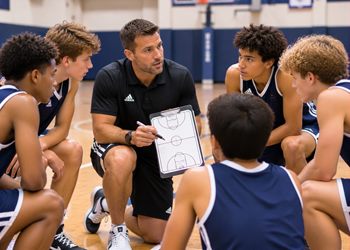
The opponent just scored three straight layups, your point guard threw the ball into the second row, and your bench is looking at you with wide eyes. You call a timeout to stop the bleeding, then spend the next 45 seconds rattling off three different corrections--box out, meet the pass, slow down--while players nod blankly and repeat the exact same turnover on the next possession.
That panic-driven huddle is why so many youth timeouts fail to change the game. Calling a timeout with calm, decisive control starts before the buzzer ever sounds: knowing which on-court moments actually justify burning a stoppage, delivering one clear cue players can execute right away, and rehearsing that reset in practice. A skill sticks when practice looks like the game--running quick huddle resets and single-cue adjustments inside live scrimmages makes game-day timeouts second nature.
Four Game Triggers That Actually Warrant a Timeout
As BasketballXpert contributor Shane puts it in The Art of the Basketball Timeout, "A well timed timeout is a definite art in the game of basketball. Timeouts can be used to stop the other team's momentum, reorganize your own team or plan a specific situational offensive play or defense." They also let you make a clean substitution or buy tired legs a rest.
The trap is calling one out of frustration after a single bad pass. As Common Mistakes of a Basketball Coach points out, yanking players or halting play after every mistake robs them of the chance to problem-solve and handle adversity on their own. Knowing when to intervene depends on your team's mentality--some groups can play through a rough stretch, while younger or rattled lineups need you to step in sooner before a run snowballs.
Use these four triggers as practical benchmarks for your sideline, adjusting to how your specific roster handles pressure:
- Two consecutive turnovers against pressure: One live-ball turnover is a teachable moment you can fix with a quick sideline yell. Two in a row against a press or trap means your ball-handlers have lost their spacing and need a reset before the game gets away.
- A 6-0 or 8-0 opponent run with dropping body language: Watch shoulders and eye contact, not just the scoreboard. When the other team strings together three or four unanswered scores and your players stop talking on defense, use a timeout to stop the run before it gets out of hand, a principle echoed in Managing the Overtime Period in Basketball.
- A repeating structural breakdown: If you give up the same look twice--losing the weak-side cutter on backdoors or failing to stop the ball in transition--your players aren't seeing the fix on the fly. For example, in Defending the Basketball Fast Break, the priority is immediate pressure on the rebounder or outlet to delay the attack, forcing the ball wide, and hustling back behind the ball to fill lanes. If your team keeps jogging back and giving up middle layups, stop play and fix that single habit.
- Late-game clock or out-of-bounds situations: Save stoppages for end-of-quarter possessions, advancing the ball, or setting up a specific out-of-bounds play or defensive matchup when one possession decides the outcome.
The 45-Second Huddle Script: What to Say and What to Skip
You get less than a minute before the horn blows, and rushed lectures guarantee nothing sticks. "You do not have much time to get your point across during a basketball timeout," Shane writes in The Art of the Basketball Timeout. "Focus on one or two quick points and do not bombard the players with too many issues. One issue is the best and hammer your point home."
Whether your league gives you 30 seconds or 60 seconds, treat 45 seconds of real coaching time as your target--and trim the clock split if you only have a 30-second horn. Well-orchestrated timeouts produce a focused group that executes better, especially when you speak positively instead of yelling, which only rattles youth players and triggers more mistakes.
First 15 Seconds: Reset Emotion and Name the One Fix
Before you grab a marker, check your own pulse. "If your players see their coach freaking out, they will freak out," Shane warns in Managing the Overtime Period in Basketball. "Stay calm. Communicate clearly with your players. Encourage them and exude confidence."
- Take a 5-second breath pause: Let players walk to the bench, grab water, and catch their breath while you make eye contact.
- Skip the replay: Don't re-litigate who missed the box-out or threw the bad pass two possessions ago; save broader timeout strategy reviews for halftime or postgame.
- Name one concrete fix: Give one clear, actionable instruction--such as "Pick up the ball at half court" or "Strong-side corner clears out"--and stop there.
Next 30 Seconds: Diagram the Next Possession and Check Recall
With emotion settled, show players exactly what the next possession looks like. Using a blank court diagram--like the free Printable Basketball Court on BasketballXpert--lets you sketch only the upcoming play or breakdown without cluttering the board with old markings. As contributor Johncd notes, a clean printable court is built specifically "to help you draw up new plays or use during time-outs to demonstrate plays or breakdowns during the game."
- Diagram only the next possession: Mark the five spots and the first two actions--nothing more.
- Assign one anchor job: Point directly to your ball-handler or anchor defender and state their single responsibility (for example, "Jordan, you're calling out the screen").
- Check recall before breaking: Ask one player to repeat the job back in five words or less, then break the huddle on "One, two, three, together!" That three-second check confirms they actually heard you.
Matching Your Huddle Message to the Players in Your Gym
Not every team is ready for the same timeout adjustment. As Shane notes in Beginning Coaches Should Focus on the Basics, "When coaching young basketball players, it is important to approach the game from a simple plot and then add the frills and skills as the players progress." Age is a rough guide, not a strict rule--a seasoned fifth-grade travel squad may handle more detail than a brand-new eighth-grade rec team, so match your message to the composure and skill level in your gym.
- Younger or developing teams: Stick to one simple effort, spacing, or possession cue. Focus on fundamentals from that same guide--protecting the ball ("Chin the rebound, look up the floor"), passing instead of over-dribbling, and hustling back--so players can play fast without overthinking.
- Older middle school and high school teams: You can pair that energy reset with one tactical tweak, such as switching your ball-screen coverage or shifting into a different press-break alignment. Even with varsity-aged players, stick to one tactical change per huddle so execution stays sharp.
Practice Blueprint: The 30-Second Timeout Scrimmage
Most coaches practice plays and drills all week, then expect players to absorb a 30-second game-day adjustment cold. Following The Importance of Planning in Basketball Practices, build timeout execution into your practice plan using a whole-part-whole approach: play live basketball, isolate one breakdown in a quick huddle, and immediately test the fix at game speed.
This blueprint adapts the live whistle-interruption format of BasketballXpert's Basketball Defensive Transition Drill and the rotating half-court competition of 4v4 Round Robin (which scales cleanly to 5v5 depending on your numbers). Adjust the block length or number of timeouts to fit your gym time.
- Court Setup & Gear: Full-court 5v5 (or half-court 4v4 if you have 8-9 players) with a printed blank court diagram and dry-erase marker waiting on the sideline.
- Rotation: Split your roster into two 5-player teams (or three rotating teams of 4 playing to 10 points). Run two 6-minute live blocks, subbing on the fly or between blocks so every player gets reps.
- Time & Rep Target: Call 3 simulated timeouts per 6-minute block--6 total huddles--giving yourself strictly 30 seconds per huddle on a visible stopwatch.
- Execution Flow:
- Play live basketball for 60-90 seconds until a natural breakdown happens (a turnover against pressure, poor transition spacing, or a missed box-out).
- Blow the whistle and signal a timeout--players sprint to the sideline bench area.
- Run your compressed script: 5-second breath, one cue ("Eyes up, breath, one job"), a quick sketch on the printed court diagram, and a one-line player recall check.
- Send both teams back onto the floor for the very next possession and score whether they execute that single adjustment.
Sideline Mistakes to Cut Before Your Next Game
Even a sharp huddle script falls apart if your sideline habits work against you. Before your next tip-off, audit these four common traps--remembering that wild game flow or tight foul trouble can occasionally force an exception:
- Burning your timeouts too early: Know your timeout situation and aim to save at least two stoppages for the fourth quarter so you aren't helpless when the clock matters most.
- Talking before players reach the bench: Don't shout instructions across the floor while players are still walking toward you; wait until all five are in the huddle and looking at your eyes.
- Drawing up brand-new plays: As Shane emphasizes in Common Mistakes of a Basketball Coach, "Don't panic. So many basketball coaches jump out of their system and try crazy things when the game isn't going right. Stick to your plans. Stick with your system. Do what your team does best." A timeout is for sharpening what you already rep in practice, not inventing a play from scratch.
- Calling a timeout on a dead-ball turnover: Unless you are setting up a specific full-court press or a late-game alignment, save the stoppage--let your defense match up naturally instead of giving the opponent a free huddle to organize their offense.
When you rehearse quick resets in practice and bring one clear fix to the bench, timeouts stop feeling like damage control. You step onto the court with calm, decisive control, your players know their exact job, and your team goes right back to playing confident basketball.