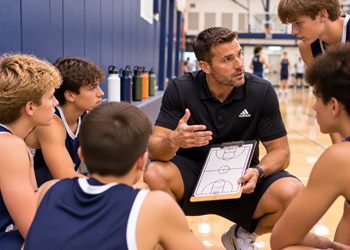
You have 60 minutes in a noisy gym, 12 kids bouncing basketballs, and a parent asking about Saturday's schedule. That is the worst possible moment to guess whether a player who just hit the floor is okay, realize nobody has had water in 35 minutes, or notice two players limping through your fifth full-court sprint.
You do not need a medical degree to run a safer gym, just a better plan on paper before the whistle blows. When you build safety checkpoints directly into your practice sheet, you walk onto the court with calm confidence instead of scrambling in the moment. Practice gets better when the plan is already diagrammed--with your setup, time blocks, coaching cues, and a way to print it before you leave the house.
Safety Starts on Your Practice Plan (Not Medical Advice)
Not medical advice: This guide shares coach-level preparation and safety habits, not medical advice. Youth coaches are educators, not doctors, and nothing here replaces a physician's evaluation. Families should always consult a licensed healthcare professional before starting a new exercise plan or clearing an athlete after an injury.
Most in-practice safety mistakes happen because we try to manage safety by feel while running a clock. As BasketballXpert contributor Shane notes in The Importance of Planning in Basketball Practices, "A little planning can make your life as a basketball coach much easier and your practices flow much smoother." Spending ten extra minutes before practice keeps you from winging it when the gym gets chaotic.
That same habit protects your players. Write your water breaks, workload caps, and a quick sideline concussion checklist right onto a Printable Blank Basketball Court alongside your drills. A printed plan cannot prevent every collision on the hardwood, but it removes the guesswork so you can act fast and keep the session sharp.
Concussion Recognition and Removal: The CDC HEADS UP Protocol
A concussion is a brain injury caused by a bump, blow, or jolt to the head or body--and it does not require a player to get knocked out. Because symptoms can show up right away or develop hours later, your job on the sideline is never to diagnose an injury. Follow the CDC HEADS UP recognition and removal protocol so you know what to watch for and what to do in the first 30 seconds.
What to Watch For After a Collision or Hard Fall
Any time two players collide for a loose ball, take an elbow to the jaw, or hit the back of their head on the hardwood, stop play and look closely. Under CDC HEADS UP guidelines, watch for visible signs and ask about player-reported symptoms right away:
- Visible signs you can spot: The player looks dazed or stunned, moves clumsily, forgets a play or defensive assignment, answers questions slowly, loses consciousness (even briefly), shows sudden mood or behavior changes, or cannot recall what happened right before or after the hit.
- Symptoms the player may report: A headache or "pressure" in the head, dizziness or balance trouble, nausea or vomiting, blurry or double vision, sensitivity to gym lights or whistle noise, feeling foggy or sluggish, or saying they just do not "feel right."
If you see any red-flag emergency danger signs--a worsening headache that will not go away, repeated vomiting, increasing confusion or agitation, slurred speech, weakness or numbness, convulsions, or trouble waking up--call 9-1-1 immediately.
The Sideline Rule: When in Doubt, Sit Them Out
Even if a player begs to go back in and tells you they feel fine, do not try to judge the severity on the bench. Follow the CDC HEADS UP rule word for word: "When in doubt, sit them out."
Use this four-step sideline checklist every time:
- Remove the player immediately from practice or the game.
- Keep them out for the rest of the day. Never allow same-day return to play after a suspected concussion.
- Notify parents or guardians right away and explain what you observed on the floor.
- Require written medical clearance from a qualified healthcare professional before the player returns to court activity.
Your verbal cue to the player is calm and firm: "Your health comes first--grab a seat next to me and we will call your parents."
Scheduled Hydration That Keeps Practice Moving
Waiting until a player asks for water means you are already behind. Kids produce more heat and sweat less efficiently than adults, and thirst is a late signal--by the time a player begs for the fountain, mild dehydration has already started to chip away at their focus and energy.
Do not lose five minutes of gym time to a single hallway water-fountain line. Instead, stage every player's water bottle along the baseline or team bench before warm-ups, and write 60-to-90-second water breaks every 15 to 20 minutes directly onto your practice plan. Plain cold water is all your players need for practices under an hour.
Based on American Academy of Pediatrics (AAP) guidance, aim for roughly 5 ounces (about 10 gulps) every 15 to 20 minutes for younger kids around 88 pounds, and 9 ounces (about 20 gulps) for older youth players around 132 pounds. While drills are running, watch for early dehydration and fatigue cues--heavy legs, dropped defensive hands, slow closeouts, and mental lapses--and use your scheduled whistle to reset the group before form falls apart.
Preventing Overuse Without Killing Competitive Energy
Young players love to compete, and high-energy practices do not require marathon running. Roughly half of all youth sports injuries come from overuse, and repetitive jumping and sprinting on hardwood can irritate growing joints--showing up as sore knees right below the kneecap, sore heels, or aching shins. Never brush off persistent joint pain as "just growing pains"; pull the player from high-impact reps and let their parents know.
Basketball is a game of starting, stopping, and jumping in short bursts. As Shane explains in The Primary Goals of Basketball Conditioning, conditioning drills should be 15 seconds to 2 minutes long and movement-specific rather than straight-ahead distance running. Long lines of full-court suicides wear down young legs without making players better at basketball.
Protect growing bodies in your weekly routine with three simple adjustments:
- Cap high-impact reps: Limit consecutive max-effort jumping and full-court sprints, and alternate intense drills with lower-impact skill work like ball handling and form shooting.
- Keep stations moving: Split into small groups at multiple baskets so players stay active in short bursts instead of standing in long lines and then sprinting cold.
- Coordinate with parents on rest: Encourage AAP-recommended recovery habits--1 to 2 rest days per week, 2 to 3 months off from a single sport each year, and multi-sport play before puberty--and ask parents how many outside games a player has that week before piling on extra conditioning.
A Ready-to-Run 60-Minute Safety-First Practice Blueprint
Here is a complete 60-minute plan you can diagram on a Printable Blank Basketball Court, tape to your clipboard, and run tonight. Every transition has built-in water stops, small-group spacing, and clear workload caps.
Minutes 0-8: Dynamic Ball-Handling Warm-Up
Run the Basketball Ball Handling Warmup, curated by Coach Chris Johnson and the BasketballXpert Coaching Team, to wake up feet and hands without high-impact jumping.
- Setup: Spread players in a half-court grid with one basketball each and plenty of elbow room.
- Rotation: Switch dribbling tasks every 20 to 30 seconds (right hand, left hand, quick direction changes, figure-8s, and spider dribbles).
- Coaching cues: "Eyes up in the grid!" and "Keep it fresh--mistakes mean you are pushing your speed."
Minutes 8-10: Water Break #1 (90 Seconds)
Send players straight to their staged baseline bottles for 10 to 20 gulps. Review the next two station spots while they drink.
Minutes 10-40: Two 15-Minute Skill Stations (With Water Break #2 at Minute 25)
Split your roster in half across two baskets to eliminate standing around and mix movement patterns. Run each station for 13 to 14 minutes, take a 90-second water break at minute 25, and rotate.
- Station 1 -- Five Point Passing Drill (Curated by Coach Chris Johnson and the BasketballXpert Coaching Team): Set up groups of 5 in a 10-foot square (4 players on the corners, 1 in the middle) with 1 ball per group. Players pass diagonally or to a side and immediately follow their pass to the receiver's spot, rotating chest, bounce, and overhead passes with zero line waiting. Cue: "Step into the pass and move your feet!"
- Station 2 -- Combo Shooting for 2 (Curated by Coach Chris Johnson and the BasketballXpert Coaching Team): Pair players at a basket with one ball each, rotating through three spots (perimeter, free throw, and layup). This keeps jumping volume controlled while building footwork. As Coach Chris Johnson and the BasketballXpert Coaching Team emphasize, "Even though the players are shooting quickly, focus on good shooting form and getting the body square with a good follow through." Cue: "Square your hips, hold your follow-through."
Minutes 40-42: Water Break #3 (90 Seconds)
Final baseline hydration stop before live play. Check in on anyone looking sluggish or favoring a knee or heel.
Minutes 42-57: Controlled Scrimmage With Built-In Rest
Run 4v4 Round Robin (Curated by Coach Chris Johnson and the BasketballXpert Coaching Team) on a half court so recovery is built straight into the rules.
- Setup: Split 12 players into 3 teams of 4 (or run 3v3 for smaller rosters).
- Rotation: Two teams play to 10 points, checking the ball outside the 3-point line, while the third team rests on the sideline and rotates in next.
- Coaching cues: "Talk on screens!" and "Reset your stance--no reaching when you are tired."
Minutes 57-60: Cool-Down and Parent Check-In
Bring the group to center court for three slow deep breaths, one quick hustle highlight from the session, and a reminder to hydrate after practice. If anyone took a hard fall or sat out with joint soreness, pull their parent aside at pickup before the gym clears.
When your practice is already diagrammed--with your setup, time blocks, coaching cues, and a way to print it--you do not have to choose between a sharp, competitive gym and a safe one. You walk in prepared, coach with calm confidence, and send healthy players home ready for the next game.