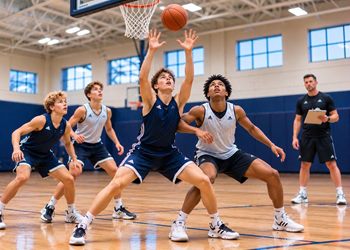
You yell "Box out!" from the bench all game, yet opponents still grab offensive rebounds and putbacks. Your players stand straight-legged under the basket, watch the ball arc through the air, and get beat by an attacker slipping inside.
The fix is not louder reminders or another static line drill. Rebounding becomes an automatic habit when practice looks like the game through whole-part-whole reps. Give your players a clear three-step box-out habit and a ready-to-run 15-minute rebounding progression this week so they stop ball-watching and finish defensive possessions with confidence.
Why Players Ball-Watch Instead of Boxing Out
Rebounding swings youth games because defensive boards limit your opponent's shot attempts while offensive boards create high-percentage putbacks for your team, as outlined in BasketballXpert's Basketball Rebounding Drills. Yet most youth players treat rebounding like a guessing game--they track the flight of the ball first and look for an opponent second.
From the bench, that habit is easy to spot:
- Straight legs: Players stand tall on their heels instead of sitting in a ready stance.
- Eyes glued to the rim: Defenders turn their heads toward the basket and lose sight of their matchup.
- Attackers slipping inside: While defenders watch the arc, offensive players take a quick first step around them or counter with a spin move to get even or in front, a breakdown highlighted in Becoming a Better Offensive Rebounder.
Height helps on the glass, though work, passion, anticipation, and positioning matter just as much--provided players expect every shot to miss rather than waiting to see if it goes in. As Ideas on Becoming a Better Rebounder puts it: "Expect a miss on every shot. Never be surprised by a ball coming off the rim."
Blocking out starts with inside position, getting into your matchup, and taking away their clean path to the ball. As Defensive Rebounding Tips notes: "If you dont get it, then your man doesnt get it either!" Yelling "box out" after the shot is already in the air comes too late; instead, shift to a whole-part-whole sequence built around shot recognition so players trigger contact the instant a shooter rises.
The Three-Part Box-Out and Rebound Habit
BasketballXpert breaks rebounding into six core components--attitude, positioning, feet positioning, body positioning, catching at the highest point, and landing--and lays out the exact sequence in Basketball Rebounding Drills: "When the shot goes up, each defender finds their player, makes contact, pivots to put their back against them, and holds a wide base with hands up. Only then do they go for the ball, with two hands."
Mechanics alone will not stick if you only rep them in uncontested lines, so package that sequence into three simple habits your players can execute at game speed.
See Ball, See Man: Locate, Pivot, and Seal
Before the ball ever hits the rim, teach players to keep peripheral vision on both their matchup and the shooter--"see ball, see man." The moment the shot goes up, your cue is "shot up, find a body."
- Step into space: Players step toward their matchup first to close the cushion before turning.
- Make contact, then turn: Use a front or reverse pivot to put hips into the attacker's thighs with forearms up and elbows wide. Call out "make contact, then turn" so players feel where the offense is before spinning.
- Hold a wide, low base: As BasketballXpert's Basketball Rebounding Drills states, "Position feet to form a strong base - feet shoulder width apart, low position with knees bent, hands up," using the body to move the opponent out of the ball's path.
What to correct: Watch for players who spin blindly toward the rim as soon as the ball goes up. When a defender turns without feeling contact first, an offensive player simply slips around their back. Freeze the rep, have the defender put a forearm on the attacker's hip before pivoting, and remind them that most misses bounce to the backside of the rim and longer shots produce longer rebounds (Defensive Rebounding Tips).
Pursue the Ball and Chin the Rebound
Once the ball comes off the rim and the defender has held their seal, they release to attack the rebound--not wait for it to drop. Explode toward the ball, catch it at its peak with two hands, and protect it immediately on landing (Basketball Rebounding Drills).
- High-point catch: In the Basketball Shooting After Rebound Drill, players read the flight off the rim or backboard and follow two core cues: "Collect the rebound at it's highest point. Keep the ball high over head when landing."
- Two-foot landing: To build safe, balanced jumping habits, The Backboard Touch trains players to explode off two feet to touch the backboard with both hands, then land two-footed on their toes with knees bent to absorb energy.
- Chin and outlet: Immediately pull the ball tight under the chin with elbows out ("chin the rebound") and scan for an outlet pass. Never let players drop the ball to their waist or dribble in traffic, where smaller defenders can strip it.
A 15-Minute Whole-Part-Whole Rebounding Station
You do not need half of practice to build this habit. Use this 15-minute whole-part-whole progression across multiple baskets in small groups so every player gets high-rep touches without standing in line. The 3/6/6-minute timing and the stop-counting rule below are a coaching structure built around BasketballXpert's drills rather than a single drill's prescribed clock.
- Minutes 1-3 (Whole -- Live 3-on-3 Baseline): Run 3-on-3 half-court play using 4v4 Round Robin adapted to 3v3 (three teams rotating at a basket; when the defense secures a rebound or steal, they clear it outside the 3-point line to become "hot" and score). Keep your whistle quiet for these three minutes and simply diagnose who loses their matchup on the shot.
- Minutes 4-9 (Part -- Closeout-and-Seal Reps): Split into pairs at every available hoop for 1vs1 Close-Down/Box-Out.
- Setup: 2 players, 1 basketball. The defender starts under the basket; the attacker starts at the free-throw line.
- Action & Rotation: The defender passes to the attacker, sprints to close out, and both battle to box out and rebound the shot before switching roles. Run to 10 rebounds or 3 minutes per side, and add a shot-fake-and-drive variation if players over-commit. (If you are short on baskets, run Around the World Rebounding with shooters spaced around the 3-point arc and one defender in the lane closing out and boxing out around the arc.)
- Verbal cues: "Shot up, find a body" and "Make contact, then turn."
- Minutes 10-15 (Whole -- Live 3-on-3 with Stop Rule): Return to 3-on-3 half-court using Three Stop Halfcourt adapted to 3v3, where the defense must string together three consecutive stops to rotate onto offense. Layer in one strict rule: a defensive stop only counts if all three defenders box out, the rebounder chins the ball with two hands, and the team completes a clean outlet pass.
Coaching Rebounding Decisions in Live Play
Carrying practice habits into Saturday games comes down to knowing where youth teams break down most often: weak-side help rotations. When a weak-side defender steps into the lane to help on a drive, they tend to stare at the ball handler and lose track of the shooter or cutter behind them on the opposite wing or corner--right where long rebounds and backside misses often land.
A smaller team can still win the rebounding battle when all five players commit to position and effort: everyone boxes out, guards chase long rebounds outside instead of leaking out early, and players anticipate that shots from the wing or corner frequently bounce to the opposite side of the rim (Basketball Rebounding Drills; Ideas on Becoming a Better Rebounder). On offense, decide before tip-off which players crash the weak side on the shot and which guards sprint back so offensive rebounding never gives up easy transition layups.
To keep players accountable without guesswork, track your boards on BasketballXpert's free Printable Basketball Stats Sheet: "When marking rebounds on the printable basketball stats sheet, mark offensive rebounds with a circle, and a slash (/) through a defensive rebound." Because that sheet records rebound totals rather than box-out effort itself, have an assistant or manager tally missed box-outs in the margin so effort gets the same spotlight as the stat line.
Replace generic "Box out!" shouts from the bench with short, actionable cues players can hear and execute immediately:
- "See ball, see man!" (when weak-side help rotates)
- "Find a body!" (the instant a shooter rises)
- "Backside!" (reminding weak-side defenders to seal the opposite side of the rim)
- "Two hands, chin it!" (the moment the ball leaves the glass)
When practice looks like the game--moving from live 3-on-3 to focused closeout-and-seal reps and right back into live play--rebounding stops being a sideline lecture and becomes an automatic habit. You replace the frustration of second-chance points with a simple, repeatable teaching sequence your team can execute this week.