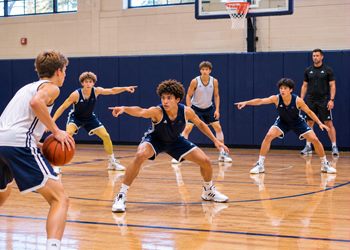
Three minutes into the first quarter, your man-to-man defense gives up two straight-line drives and a backdoor layup. Your players are ball-watching, nobody talks on the weak side, and the urge to call a timeout and drop into a 2-3 zone hits fast.
Switching defenses mid-game feels like an easy fix, but it rarely solves the real problem when your practice drills do not match game speed. Defensive habits stick when practice looks like the game: use whole-part-whole--live play, one targeted breakdown, and back to live basketball--so players execute on game day whether you play man-to-man or zone.
Why Youth Coaches Reach for Zone--and What It Costs Players
When a youth team's man-to-man breaks down, the symptoms look obvious from the bench: defenders stare at the ball, get beat off the bounce, and lose cutters behind their back. As BasketballXpert's man-to-man defense guide explains, effective man-to-man requires off-ball awareness so defenders can track cutters and anticipate passes instead of locking their eyes onto the ball alone.
"Be aware! Know what is going on around you. Do not just lock in on the ball. Being aware will allow you to help when needed. You'll see cutters and be able to anticipate where the ball is going better." -- Shane, BasketballXpert contributor
In the heat of a game, it is tempting to abandon your system and hide those breakdowns in a passive zone. Yet BasketballXpert's common coaching mistakes guide warns that jumping out of your system when things go wrong is a classic coaching trap.
Parking players in a zone too early carries a real developmental cost--even if it steals a few ugly possessions on Saturday morning. From the bench, watch what happens in a passive zone: defenders stand flat-footed in the paint watching the ball instead of guarding space or a player with active feet. Players miss out on the 1-on-1 footwork, controlled closeouts, and help-and-recover instincts they will need at every higher level.
When to Teach Man-to-Man vs. When Zone Concepts Fit
Forget chasing a magic age number to decide your defense. Choose your base defense by what your players can actually execute under pressure, not by what looks tidy on a whiteboard.
As BasketballXpert's guide for beginning coaches emphasizes, youth coaching works best when you keep things simple and build fundamentals and footwork before layering on advanced concepts. Until your players can move their feet, locate the ball and their matchup, and talk on the floor, adding complex schemes only creates more confusion.
Build Man-to-Man as Your Base Defense First
Every youth team needs man-to-man as its foundation because it teaches individual accountability. When a player is responsible for one opponent, they cannot hide in a crowded lane.
Start by teaching the core priorities outlined in BasketballXpert's man-to-man defense guide:
- Pressure the ball: Stay arms-length away to limit the ball handler's vision and stop quick attacks.
- Deny the middle: Angle your body to force the ball wide toward the sideline rather than letting drivers split the paint.
- Keep active hands: Sit in the passing lanes to discourage easy entry passes without over-reaching.
- Stay aware off the ball: Track both the ball and your matchup so you can help on drives and pick up cutters.
"Get pressure on the ball! It is key number one. Getting pressure on the ball limits the decision making process of the player with the ball and stops quick attacking." -- Shane, BasketballXpert contributor
That individual accountability is exactly why many youth leagues--along with USA Basketball and NBA Youth Guidelines--restrict zone defenses at younger age levels. They want players learning footwork, positioning, and communication first, though you should always check your local league rules before installing anything new.
When Layering in Zone Concepts Makes Sense
Once your players already close out under control, see ball and man, and communicate early, zone concepts like a 2-3 or 1-3-1 become a useful tool rather than a crutch. That readiness--combined with your league's rules--is your green light.
Layer in zone principles in specific situations:
- Protecting foul trouble: Keep a key defender out of foul trouble without sacrificing rim protection.
- Changing game tempo: Throw a different look for three or four possessions late in a game to disrupt an opponent's offensive rhythm.
- Teaching gap-help: Reinforce how defenders shrink driving lanes together and rotate as the ball moves.
Watch closely from the sideline when you run a zone: if your players stop closing out to shooters or stop talking because they think "that's someone else's area," the zone has gone stationary. A good zone moves on the pass with the exact same urgency as man-to-man.
The Three Defensive Habits That Make Either Defense Work
Whether you call man-to-man or zone, the same three habits decide if your defense holds up at game speed. Teach these habits in every drill, because schemes do not get stops--players with habits do.
1. Balanced stance and under-control closeouts
According to BasketballXpert's defensive fundamentals guide, defenders must stay low, move on their toes, and beat opponents to the spot with their feet instead of reaching--because reaching leads to fouls and blow-bys. When closing out to a shooter, sprint the first two-thirds of the distance, then "chop your feet" with high hands for the final steps so you arrive balanced.
If a defender lunges past the shooter on a closeout, stop the rep and have them finish low with wide, choppy steps. You can also reinforce body angle with Basketball Defensive Channeling, which trains defenders to use lateral footwork to funnel a ball handler toward the sideline or into help.
2. "See ball, see man" triangle positioning in help
Off-ball defenders should form a flat triangle where they can point one hand at the ball and one hand at their matchup without turning their head back and forth. Cue "see ball, see man" every time the ball is passed.
When a defender turns their head away from the ball or hugs their matchup two passes away, freeze the play for three seconds. Have them take two steps toward the midline, open their chest to the ball, and point both pistols before resuming.
3. Early, loud communication
In BasketballXpert's defensive basics, constant communication sits right alongside quick feet and transition effort as a non-negotiable habit. Quiet defenses always break down on screens, cutters, and rotations.
"Always be talking and giving information to your teammates. Be ready to help them out if they are in trouble. The more information you and your team shares the easier it is to be prepared and in good defensive positions." -- Shane, BasketballXpert contributor
Give players simple, loud cues they can bark before the catch: "ball," "I got help," and "cutter." A good rep sounds noisy from the first pass to the defensive rebound.
Whole-Part-Whole Practice Blueprint: 25-Minute Defensive Block
You do not need an hour of shell drill cones to fix game-day breakdowns. Run this 25-minute whole-part-whole block twice a week so players experience the game problem, isolate the fix, and immediately apply it back in live play.
Whole (5 Minutes): Expose the Breakdowns
Run 4v4 Round Robin on one half court--or 3v3 if you have fewer than 12 players--which leaves extra floor space and forces honest 1-on-1 defense and communication. Check the ball outside the three-point line and add a two-dribble limit per catch so the ball moves quickly and exposes late closeouts and poor help positioning.
- Rotation: Play to 3 points or 90 seconds, then rotate the waiting group in on defense.
- Coach focus: Do not stop play to lecture. Take two mental notes on what is breaking down--closeouts, weak-side help, or silence.
Part (10 Minutes): Two-Station Breakdown
Split your team into two stations for 5 minutes per station, aiming for 4-6 high-intensity reps per player before rotating baskets.
- Station A -- Closeout-to-Live 1-on-1 Containment: Set up 1vs1 Close-Down/Box-Out. The defender starts under the basket, passes to an offensive player at the free-throw line, sprints out to close down the shooter (allowing a shot fake and live drive), and finishes by boxing out. If you want pure dribble containment, mix in 1v1 basketball game, where the defender guards from the free-throw line for two possessions and fouls count as offensive points.
- Cues: "Chop your feet" on the closeout; "chest in front, no reach" on the drive.
- Station B -- Triangle Help-and-Recover: Place three offensive players on the perimeter (top and two wings) with three defenders in help-and-recover spots. Offensive players pass around the arc on your whistle while defenders jump to the ball on every pass, then go live for one drive-and-kick sequence on your "go" call.
- Cues: "Jump to the ball" on the flight of the pass; "see ball, see man" and "I got help" before the catch.
Whole (10 Minutes): Back to Live Basketball
Bring both groups back together for Three Stop Halfcourt. Two teams of four compete in the half court, and the defensive group stays on defense until they earn three consecutive stops--defined as a missed shot with a clean defensive rebound or a turnover.
- Constraint: Defenders must call out "ball," "help," and "cutter" before the catch, or a stop does not count.
- Why it works: Players immediately transfer their closeout footwork and triangle help into a competitive game setting where consecutive stops actually matter.
What to Watch and Say on Game Day
When the other team scores twice in a row on Saturday, take a breath before ripping up your game plan. As BasketballXpert's common coaching mistakes guide reminds coaches, panicking and abandoning your system mid-game rarely helps--use stoppages and substitutions to make calm, specific corrections instead.
"Don't panic. So many basketball coaches jump out of their system and try crazy things when the game isn't going right. Stick to your plans. Stick with your system." -- Shane, BasketballXpert contributor
Before calling a timeout, pinpoint the actual leak:
- Point-of-attack containment: Are guards getting beat off the dribble because they reach instead of moving their feet?
- Weak-side cuts: Are off-ball defenders ball-watching and losing backdoor cutters?
- Defensive rebounding: Are you getting one-and-done stops, or giving up second-chance layups because players watch the shot instead of blocking out? As BasketballXpert's defensive rebounding tips note, keeping inside position on a box-out matters even more on longer shots, which produce longer rebounds--and most misses bounce to the backside.
When you call a 30-second timeout, keep it simple. BasketballXpert's guide to the basketball timeout stresses that coaches have very little time and should hammer home one single issue instead of bombarding players with five adjustments.
"Focus on one or two quick points and do not bombard the players with too many issues. One issue is the best and hammer your point home." -- Shane, BasketballXpert contributor
Pick one clear fix for the huddle:
- "Jump to the ball on every pass--no flat feet on the weak side."
- "Chop your feet on the closeout and keep your chest in front."
- "Find a body first and chin the rebound before looking to outlet."
After the game, check the numbers before deciding your defense failed. Track defensive rebounds, steals, blocks, and opponent shot attempts on BasketballXpert's free Printable Basketball Stats Sheet. Have an assistant tally paint touches and fouls in the margin so you know whether you gave up easy layups or just ran into hot perimeter shooting.
When your practice plan follows whole-part-whole--live play, one sharp breakdown, and back to live basketball--you walk onto the sideline with clarity. You know what your players have practiced, you know what to fix in a timeout, and you can trust your defense to hold up on game day.