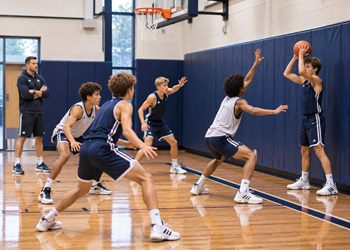
Your team walks through inbounds plays cleanly in practice, then panics the moment a game gets loud--burning 5-second calls, throwing blind lob passes, or dribbling straight into sideline traps. Composure under game-day pressure does not come from memorizing ten complex sets. It comes from building habits in live-speed reps.
A skill sticks when practice looks like the game. Teach whole-part-whole: play, isolate one breakdown, then go back to live basketball.
Below are three simple inbounds plays, a pass-first press-break structure, and a 15-minute practice block you can run this week so your players stay calm and protect the ball.
Why Youth Teams Panic on Inbounds and Against the Press
Most game-day press turnovers happen before the ball even crosses half-court because 5-on-0 walkthroughs hide three habits: poor spacing, hiding behind defenders, and picking up the dribble near the sideline. Without a defender in their jersey, young players jog to spots and assume the pass will arrive.
On game day, watch for three warning signs:
- Staring at one target: The inbounder locks onto the point guard while three other teammates stand covered.
- Turning the back to the floor: Receivers catch the ball facing their own basket and immediately put their head down to dribble.
- Soft lob passes: Players try to throw over a defender's outstretched arms instead of stepping around the pressure with a crisp bounce or chest pass.
As BasketballXpert contributor Shane notes in Beginning Coaches Should Focus on the Basics: "The fastest way to attack in basketball is with the pass. Why do coaches allow players to dribble when they can pass so much faster? One most common faults in basketball is dribbling too much." Every extra bounce raises the odds of a turnover, and no defender can outrun a sharp pass--though a pass only works when teammates move into open passing lanes first.
Just as important, keep your own sideline voice steady. In Common Mistakes of a Basketball Coach, BasketballXpert advises coaches not to panic or yell from the bench when things go wrong, because yelling rattles young players and leads to more mistakes. Fine-tune your press break in practice and use calm cues from the sideline:
- "Chin it" the moment a player catches under pressure.
- "Show your numbers" so cutters open their chest to the ball.
- "Pass out of the trap" before two defenders close the pocket.
3 Simple Inbounds Plays You Can Install in One Practice
You do not need a thick playbook for baseline out-of-bounds (BLOB) or sideline out-of-bounds (SLOB) situations. Teach players to read defenders rather than memorize rigid choreography.
Before you rep any set, train your inbounder to sell a fake first. The Fake Shot or Fake Pass and Take to the Hoop drill teaches players to use a quick pass fake to move a defender before attacking open space, progressing from shadow defense to 50% and 100% live pressure. A crisp fake on the baseline buys the extra half-second your cutters need--though it only helps if the inbounder keeps their eyes scanning all four teammates.
Play 1: Baseline Stack for a Quick Rim Cut or Corner Catch
Use a 4-player stack on the low block or lane line (ball-side) to force defenders to communicate through traffic.
Alignment and reads:
- Line up four players single-file on the ball-side lane line, facing the inbounder, with the best finisher at the front and a shooter near the back.
- On the referee's slap of the ball, the front player flares hard to the ball-side corner for a quick catch-and-shoot or safe entry.
- The second player cuts off the third player's hip straight to the rim for a layup.
- The third and fourth players step out toward the free-throw line and opposite wing as safety outlets.
What to watch for: Young players love to break early before the referee hands over the ball, which ruins the timing and crowds the baseline.
Verbal cues: "Wait for the slap" and "Cut off the hip."
To sharpen the corner-and-rim finishing footwork, pair this read with the Basketball Offensive Drill - Swing passing, cut and finish at the rim, which stations two players on the baseline and three around the arc to rep sliding along the baseline and cutting hard to finish.
Play 2: Baseline Line-Up for an Open Jumper or Safe Reset
When defenders pack the paint against your stack, line up four players across the free-throw line extended to create clean screening angles.
Alignment and reads:
- Place all four teammates shoulder-to-shoulder across the free-throw line extended, facing the baseline.
- On the whistle or slap, the inside two players set side-by-side screens for the outside players, or use a simple screen-the-screener action where one wing curls to the elbow for an open jumper.
- The inbounder's second look is the screener slipping back toward the ball-side mid-post or out to the top of the key for a safe reset.
What to watch for: Players slipping screens too early without making contact, leaving the cutter still guarded. Teach solid screen angles using the Pick And Roll Drill, which emphasizes setting a strong, balanced pick so teammates can rub shoulders into open space without letting a defender split the screen.
Verbal cues: "Hold the screen for two" and "Eyes on the ball."
Play 3: Sideline Safety to Beat Tight Denial
When the defense denies every pass in the frontcourt on a sideline inbounds, give your team a built-in safety valve so you never burn a timeout or take a 5-second call.
Alignment and reads:
- Set two players at the frontcourt elbows, one player in the far corner, and your best ball-handler behind the half-court line as the high safety release.
- The first look is a backdoor cut by the ball-side elbow if their defender overplays the line.
- If both frontcourt options are denied by count two, the inbounder pivots and hits the high safety release in the backcourt (when the ball has not yet crossed half-court), stepping back from the boundary for a clean passing angle.
What to watch for: Inbounders crowding the sideline--standing right on the chalk shrinks their passing angle--or panicking at three seconds and forcing a lob into traffic. Build quick-decision passing under pressure with the Five Point Passing Drill, where four players form a 10-foot square around a fifth player in the middle to practice thinking one step ahead and snapping accurate chest, bounce, or overhead passes.
Verbal cues: "Step back for angle" and "Hit the safety."
How to Beat a Full-Court Press Without Turning It Into a Track Meet
Full-court pressure works when it speeds up your guards and turns the game into a frantic track meet. As Shane puts it in Beginning Coaches Should Focus on the Basics: "There is no defense that can not be beaten. The offense just needs to be patient, protect the possession, and strike when the advantages are in their favor."
Instead of asking one point guard to dribble through two defenders, give all five players clear spacing lanes and attack with the pass.
Set the Floor: Middle, Sideline, and Safety Roles
Assign five repeatable roles so every player knows their lane before the ball is even picked up out of bounds:
- Inbounder / Trailer: Passes the ball in, then steps onto the court behind the ball as an immediate safety valve.
- Middle Flasher: Owns the center lane from the free-throw line to half-court, flashing toward the ball as soon as it is caught.
- Two Sideline Outlets: Line up above the deep corner trap zone along each sideline--never standing trapped in the baseline corner.
- Deep Rim Runner: Stretches the defense toward the opposite basket to keep the back line honest.
What to watch for: Four players sprinting deep the second a shot goes in, leaving the ball-handler completely isolated in the backcourt.
Verbal cues: "Own the middle" and "Meet the pass."
To groove these exact spacing lanes, run the Full Court Passing Drill to Layup, which puts one line in the middle and one on each wing--the middle player passes to a wing, gets it back, and reverses to the opposite wing before leading a teammate for a layup.
Attack the Press With the Pass, Not the Dribble
Once the ball is inbounded, teach your ball-handlers a simple rule: keep your dribble alive until you see open space, and never dribble into the sideline "coffin corner." If two defenders trap, chin the ball, find your pivot foot, and pass back to the trailer or into the middle flasher to reverse the floor.
When the ball hits the middle and beats the first line of pressure, your team has a numbers advantage going the other way. Train players to recognize and convert those 4-on-3, 3-on-2, and 2-on-1 breaks with Working on the Basketball Fast Break, and clean up full-court passing footwork with Two Line Fullcourt Passing so players deliver crisp chest and bounce passes in stride without traveling.
What to watch for: Putting the head down to split a double team or throwing soft overhead lobs across the court.
Verbal cues: "Dribble to draw two, pass to one" and "Middle breaks the press."
15-Minute Practice Blueprint: Whole-Part-Whole Press Break and Inbounds
Do not spend 15 minutes walking through plays in a quiet gym. Run this whole-part-whole block at game speed with short lines:
- Minutes 0-4 -- Whole (Live 5-on-5 Press Scenario): Play live 5-on-5 full court. Every made basket or dead-ball turnover triggers a live baseline inbounds against full-court pressure. Let players feel the speed, and note the single biggest breakdown (5-second hesitation, sideline trap, or missed middle flash) without stopping every ten seconds.
- Minutes 4-10 -- Part (6-Minute Breakdown at Two Baskets): Split the team into two half-court groups to eliminate standing in line:
- Group A (Trap Escape & Advantage): Run 3-on-2 and 4-on-3 press-break waves using the Working on the Basketball Fast Break structure. Focus on "Chin it" and "Middle breaks the press."
- Group B (4-Second Inbounds Reps): Run live 4-on-4 inbounds reps from the baseline and sideline with a loud 4-second coach count. Rotate offense and defense every 3 reps using the quick-rotation format from 4v4 Round Robin, which requires a live baseline inbounds after every score. Swap groups at the 3-minute mark.
- Minutes 10-15 -- Whole (5-Minute Game-Situation Finisher): Return to live 5-on-5 with a strict 5-second inbounds count and full-court trap rules. Award 1 bonus point for every clean press break that finishes with a paint touch or layup--keeping the energy high and the focus on composure.
Game-Day Adjustments When the Other Team Changes Its Press
Opposing coaches will switch presses mid-game to rattle young guards. Use a quick sideline read to tell man-to-man denial from a zone trap (such as a 1-2-1-1 diamond or 2-2-1):
- Man-to-man denial: Defenders face-guard individual players and chase them across the floor.
- Zone trap: Defenders guard areas of the floor and sprint to double-team the first pass near a sideline or corner.
When you call a timeout to adjust, keep your huddle brief and focused. As Shane advises in The Art of the Basketball Timeout: "You do not have much time to get your point across during a basketball timeout. Focus on one or two quick points and do not bombard the players with too many issues. One issue is the best and hammer your point home."
Pick one clear adjustment:
- Against man-to-man denial: Have a teammate screen the inbounder's defender or set a back-screen to free the safety release.
- Against a zone trap: Flash a player straight to the middle behind the first line of traps and reverse the ball immediately.
Before your next game, print a few copies of the free Printable Basketball Court diagram on BasketballXpert to map out your exact roster spots for Play 1, Play 2, Play 3, and your press-break lanes. When your players know their spots and trust their whole-part-whole practice reps, they walk onto the floor with composure--ready to handle pressure without panic.