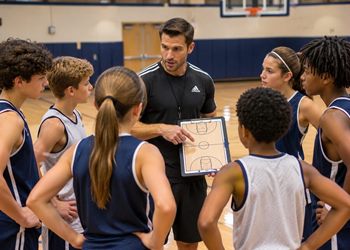
Walk into almost any youth gym on day one and you will see the same mistake: the tallest kid gets parked on the low block, the smallest kid gets handed the ball, and everyone else stands on the wing waiting for a shot. By midseason, your post player panics the second a guard pressures the ball, and your guards shy away from contact on the glass.
You do not need rigid 1-5 labels to organize a youth team. Match position teaching and skill work to who is in your gym--build universal ball handling, footwork, and team defense first, then layer role-specific responsibilities as players grow. When you treat positions as teachable, rotating jobs instead of permanent identities, you replace guesswork with a clear plan that grows every player's game.
Why Rigid Positions Hurt Youth Development (and What to Teach Instead)
Early height is a terrible predictor of who will play guard or post two years from now. Locking a tall fifth-grader under the basket robs them of perimeter footwork, while hiding a smaller player in the corner teaches them to avoid rebounding and cutting.
As BasketballXpert contributor Shane notes, "When coaching young basketball players, it is important to approach the game from a simple plot and then add the frills and skills as the players progress." Beginner work belongs to ball handling, footwork, and shooting form, while middle school adds passing, layups, and team defense--save complex sets and help-defense rotations for high school, and game-speed execution for college.
Instead of assigning permanent spots, build five universal habits across your whole roster:
- Ball handling under pressure: Run Dribbling with Both Hands (10-15 minutes, 4-12 players, Youth-College) by having players dribble two basketballs simultaneously down and back the full court, progressing to keeping their eyes up. It builds off-hand comfort fast, though younger beginners will need to start at a walk before pushing full speed.
- Passing ahead and spacing: Teach players that the fastest way to attack is with the pass, not over-dribbling.
- Purposeful cutting: Nobody stands still for more than two seconds after passing.
- Finishing through contact: Every player practices layups off both feet from both sides of the lane.
- Effort-first man-to-man defense: As outlined in Tips on Better Man to Man Defense, good defense starts with pressuring the ball, denying the middle of the floor, and keeping active hands in passing lanes rather than drifting toward the next offensive possession.
What to watch for in games: Look for taller players picking up their dribble at midcourt under light pressure, and perimeter players turning to sprint back before the rebound is secured.
What to say from the bench: Use the mantra "everyone handles, everyone cuts, everyone rebounds" so no player checks out when the ball moves away from their side of the floor.
The 5 Basketball Positions and Their Core Game Jobs
Youth players still need to know what the numbers 1 through 5 mean when they hear them in a huddle or see them on a diagram. The trick is framing each number as a job description on offense and defense--not a cage.
Before practice, print a Printable Basketball Court so players can see where each spot sits on the floor. As BasketballXpert contributor Johncd puts it, "The printable basketball court is easy to use. Just print the basketball court, and start drawing up your plays."
In transition defense, those numbers blur immediately. According to Defending the Basketball Fast Break, the closest player--regardless of position--must immediately pressure the rebounder or outlet passer to slow the initial pass and force the ball out of the middle, while teammates sprint back behind the ball to fill lanes.
Perimeter Jobs: Point Guard (1), Shooting Guard (2), and Small Forward (3)
The three perimeter spots share the job of initiating offense, stretching the defense, and attacking gaps.
- Point Guard (1): Initiates the offense, sees the whole floor, and protects the basketball against pressure.
- Shooting Guard (2): Spaces to open shooting pockets on the wing or corner, moves without the ball, and attacks hard closeouts.
- Small Forward (3): Bridges the perimeter and the paint by slashing from the wing, cutting to the rim, and crashing the glass from outside.
Common game mistakes: Perimeter players often dribble with their eyes glued to the floor or stand ball-watching on the wing while a teammate gets trapped.
Verbal cues to use: Call out "eyes up, space the floor" when the ball crosses half-court, and "cut with purpose" whenever a wing player holds the ball for more than two counts.
To sharpen perimeter decision-making, run Fake Shot or Fake Pass and Take to the Hoop (4-12 players) so guards and wings learn to shift a closing defender with a convincing fake before driving. Pair it with Basketball 1v1 Roll: a baseline defender rolls the ball out to an offensive player beyond the 3-point arc and closes out, forcing the ball handler to attack strong and finish with their weak (left) hand rather than defaulting to their dominant side. Both drills translate straight to game closeouts, though younger players will need reminders to stay on balance instead of lunging into defenders.
Frontcourt Jobs: Power Forward (4) and Center (5)
Frontcourt players anchor the paint, create space for teammates through screens, and own the backboard.
- Power Forward (4): Sets solid screens, flashes to the high post or short corner to relieve pressure, and boxes out on every shot.
- Center (5): Anchors help defense in the lane, seals defenders to create paint touches, and finishes strong through contact.
Common game mistakes: Post players often clog the driving lane by standing on the block too long, or reach down on drives instead of walling up vertically.
Verbal cues to use: Cue screeners with "screen, then open to the ball" and rebounders with "chin the rebound" the instant they secure the ball.
Use three targeted drills to build these habits:
- Pick And Roll Drill: Isolate a 2v1 action where the screener sets a wide, balanced pick so the ball handler can rub shoulders and separate, then rolls toward the hoop while opening up to face the ball handler for a clean layup pass.
- 1vs1 Close-Down/Box-Out: A defender under the basket passes to a shooter at the free-throw line and sprints to close out; both players battle for the rebound. As the BasketballXpert Coaching Team emphasizes, "Position self in flight of the ball. Positioning body low/wide stance. Position body to move opponent out of flight of the ball. Explode to rebound and catch at highest point."
- Basketball Shooting After Rebound Drill: Set 1 shooter at the free-throw line, 2 passers on the baseline, and 1 rebounder in the lane. The rebounder reads the ball off the rim or backboard, catches it high overhead, and goes straight back up without bringing the ball down to their waist.
Keep Defensive Rebounding Tips in mind as you coach this group: most rebounds come off to the backside of the rim, and longer shots produce longer rebounds, so perimeter players must box out too--not just your 4 and 5.
How to Rotate Players Through Positions Without Losing Team Structure
Coaches often worry that rotating players through perimeter and post spots will turn the offense into chaos. The solution is teaching a simple spacing shell--such as 4-out/1-in or 3-guard/2-forward--where the spots stay fixed even as the players inside them change.
Basketball Offensive Drill - Swing passing, cut and finish at the rim (10-15 minutes, 4-12 players, Youth-College) models a 3-out/2-in structure where players naturally exchange roles. Set 3 perimeter players around the 3-point arc and 2 post players on the baseline: as the wings swing the ball, the ball-side baseline player slides out to the perimeter, the backside post flashes to the top of the key, and the opposite post cuts hard to the rim to finish.
To carry that spacing into live play, run 4v4 Round Robin (10-15 minutes, 3 teams of 4 on a half court, or 3v3 for smaller rosters). Every possession must be cleared outside the 3-point line to become live, which gives players more room to attack and forces stronger 1v1 defense because less help is available. That extra space helps youth decision-making, though remind players that 5v5 games will feel tighter once the fifth defender is added.
Layer these two scrimmage rules onto your rotations:
- Any rebounder can push the break: Whoever grabs the defensive board looks to outlet or dribble out, while the nearest guard sprints the sideline.
- Fill the open spot, not the ball: Require players to sprint to the nearest empty perimeter or post spot after passing or cutting.
What to watch for: Two players sprinting to the same corner or three players trailing the ball handler down the middle.
What to say: Freeze play for five seconds and call out, "Fill the open spot, not the ball."
A 3-Station Practice Blueprint to Train Every Position's Core Skills
As The Importance of Planning in Basketball Practices points out, practices fall flat when coaches wing it and jump between unrelated drills. Build one focused 30-minute block around universal position skills--three 8-minute stations (with 1 minute between rotations) followed by a 5-minute scrimmage.
Station 1: Perimeter Ball Handling and Passing Under Pressure (8 Minutes)
- Minutes 1-4 -- Team Dribble Tag: Mark off half the court and designate one or two taggers while every player dribbles a ball. As the BasketballXpert Coaching Team instructs, "Player must keep their heads up and be aware of not only the 'it' player, but all others on the court. Recognizing space and accelerating to escape with the dribble. Do not be out of control."
- Minutes 5-8 -- Five Point Passing Drill: Place 5 players in a 10-foot square (4 corners, 1 middle). Players make crisp chest, bounce, and overhead passes diagonally and along the sides, immediately following their pass to take the receiver's spot.
- Coaching cues: "Eyes over the ball" and "step into your pass, move your feet."
Station 2: Wing Attack and Finishing (8 Minutes)
- Floor plan: Run half-court waves of Basketball 1v1 Roll for the first 4 minutes (target: 4 weak-hand drives per player), then transition to Swing Passing, Cut and Finish at the Rim for the final 4 minutes (target: 8 made rim finishes as a group).
- Coaching cues: "Sell the shot fake" and "explode off two feet."
Station 3: Screening, Rebounding, and Paint Defense (8 Minutes)
- Floor plan: Split the group into pairs at a second basket. Spend 4 minutes on Pick And Roll Drill (3 reps each as screener and ball handler before switching) and 4 minutes on 1vs1 Close-Down/Box-Out (first to 3 rebounds wins the pair).
- Coaching cues: "Screen wide, open to the ball" and "low stance, chin it."
Whole-Part-Whole Scrimmage (5 Minutes)
Finish with 5 minutes of live 4v4 or 5v5 half-court play. Every time possession changes, players must rotate one spot clockwise on the floor before checking the ball in--forcing your post players to initiate offense and your guards to screen and box out.
Game-Day Adjustments: Matching Roles to Who Is on the Floor
Even the best practice plan gets tested when foul trouble, matchups, or a full-court press hits on Saturday morning. Keep your composure first: as Shane writes in Common Mistakes of a Basketball Coach, "Use stoppages and substitutions to adjust and correct problems. If you must make adjustments real time then speak in a positive manner to the kids. Yelling and screaming does nothing but rattle the kids and lead to more mistakes."
When you need to reset the floor, use a timeout wisely. According to The Art of the Basketball Timeout, a well-timed timeout stops an opponent's run, reorganizes your lineup, sets up a situational play, or buys rest for tired legs.
Keep three simple game-day adjustments in your back pocket:
- Against full-court pressure: Put two comfortable ball-handlers on the floor together so one can always flash to the middle as a safety valve. In practice, prepare for this with Basketball Defensive Channeling, a full-court 1v1 drill that trains defensive footwork while teaching ball handlers to protect the ball and break pressure without turning it over.
- When you are undersized: Shift to aggressive weak-side help and commit all five players to team box-outs rather than asking one center to battle two bigger opponents alone.
- For a quiet scorer: Call a simple baseline cut from the weak-side corner during a dead ball so they get an easy catch near the rim without having to isolate on the wing.
Timeout correction to give players: Pull out your Printable Basketball Court diagram, point to the two spots causing traffic, and give one clear fix--such as "Guards, clear the middle after you pass so our cutter has a lane."
After the buzzer, pair your court diagram with the Printable Basketball Stats Sheet--tracking 2-pointers, 3-pointers, free throws, offensive and defensive rebounds, assists, steals, and blocks by player number--to see which lineup combinations actually defended, rebounded, and shared the ball well. Note that raw box-score numbers do not capture good screens or strong help-side rotations, so weigh the sheet against what you saw from the bench.
You do not have to guess who belongs where anymore. Match position teaching and skill work to who is in your gym, build universal habits first, and let every player earn confidence across all five spots on the floor.