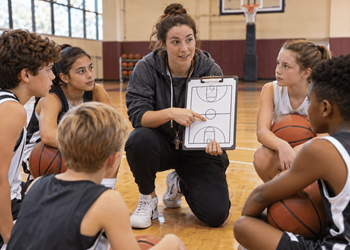
You walk into a 60-minute gym slot with 10 to 12 kids, a bag of basketballs, and no idea where to start. The noise bounces off the walls, parents are watching from the bleachers, and you worry the whole hour will turn into long lines and chaos.
Take a breath--you do not need a playbook of set plays to run a great first season. Practice gets better when the plan is already diagrammed, with clear court spots, set times, short coaching cues, and a sheet you can print before you leave the house. With three core fundamentals and a simple station structure, you can replace first-season overwhelm with quiet confidence tonight.
Pick Three Core Skills Before You Step on the Court
Trying to teach everything in week one leaves players confused and coaches exhausted. As the BasketballXpert Coaching Team puts it in Beginning Coaches Should Focus on the Basics:
"Basketball for the younger ages is a relatively simple game. Of course it gets more advanced as the player matures. But for the beginning youth coach it is a pretty basic game and should be kept so."
Younger players do not need complicated offenses or zone traps; they need habits that hold up when the ball is tipped. Anchor week one to three fundamentals, knowing youth players build these habits over weeks of repetition rather than one practice:
- Ball handling with eyes up. Teach the five core habits from How to Teach Dribbling in Basketball: knees bent, butt down, back straight; head up to see the court; fingertips on the ball (not the palm); both hands; and protect the ball by shielding it with the body. In early scrimmages, watch for players staring straight down at the floor--they miss open teammates and dribble into traps.
- Footwork and agility. Good footwork is the foundation for creating space to shoot, beating a defender to the basket, and staying in front on defense, as outlined in The Importance of Footwork in Basketball. Watch for traveling on the catch and rushed, off-balance stops; clean footwork fixes both faster than running plays.
- Balanced shooting form. In Evaluating Your Shot and Making Corrections, common beginner fixes start with squaring the body to the basket, setting the ball on the shooting side of the head between ear and shoulder, using the legs for power, aiming for a 45-to-60-degree arc, and holding the follow-through with full elbow extension until the ball reaches the rim. Shot mechanics take patience--fix balance and arc before worrying about deep range.
Also remind your team early that possession is golden and a defender cannot outrun a pass. Pick one of these three skills as your main theme each week so your players know what they are trying to get right.
Structure Your First 60-Minute Practice Around Touches, Not Lines
Nothing kills a 60-minute practice faster than ten kids standing in one single-file line waiting for a turn. BasketballXpert, curated by Coach Chris Johnson and the BasketballXpert Coaching Team since 2007, is built around a Maximum Ball Touches principle--explained on the About BasketballXpert page--because every minute spent waiting in line is a rep lost:
"Standing in long lines stunts development. We emphasize small-group stations and multi-ball drills so every player gets plenty of dribbles, passes, and shots each session."
Planning around one or two clear goals keeps the gym moving smoothly, whereas winging it leads to flat, unchallenging sessions where kids stop improving, as noted in The Importance of Planning in Basketball Practices. Pairing small-group skill work with Game-Like Random Transfer--moving from isolated technique into decision-making and small-sided games--helps skills actually show up on Saturday.
Set Up a 4-Station Rotation Blueprint
A 60-minute gym slot flies by, so break the hour into four simple blocks: a dynamic ball-handling warm-up, a four-station skill circuit, a small-sided scrimmage, and a quick competitive finish. Adjust the length of each block to your gym clock and how fast your group rotates--newer teams often need an extra minute to transition between baskets.
- Block 1: Full-group ball-handling warm-up (every player with a ball). Skip the lines--give every player a ball. As Basketball Dribbling and Ball Handling Basics warns: "One mistake coaches use is to put the players in lines and have them stand around until it is their turn to go. Give everyone a ball and have everyone working at the same time." Run Basketball Ball Handling Warmup in an open grid with one ball per player; on your whistle, players dribble freely and switch tasks every 20 to 30 seconds (right hand only, left hand only, change directions, figure-8 through the legs, spider dribble, ball-swap sprint, or knockout).
- Block 2: Four-station skill circuit. Split 10 to 12 players into four small groups of 2 or 3 at four spots (two baskets and two half-court or sideline cone areas) so nobody stands idle. Rotate groups on the whistle through one ball-handling station, one footwork/passing station, one shooting/layup station, and one defensive-stance/rebounding station. Keep each station focused on a single skill cue rather than complex rules.
- Block 3: Small-sided live play. Move straight into 4v4 Round Robin, which splits up to 12 players into 3 teams of 4 (or 3v3 if you have fewer than 12) on a half court. Two teams play to 10 points (1 point per basket, 2 points for a 3-pointer, checking the ball outside the 3-point line) while the third team rotates in. Four-on-four creates far more space than 5-on-5 for beginners to attack, pass, and defend 1-on-1.
- Block 4: Competitive game finish. End practice on a high-energy, timed shooting or layup challenge so players leave smiling and competing together.
Use Short Verbal Cues Instead of Long Lectures
Beginners tune out long speeches on the baseline, and standing still cools down the gym. Drills are only tools--as Why do Basketball Practices Fail? points out, practices fall flat without a specific goal, immediate feedback, and player concentration:
"Good coaches do not rely on just the drills to do the teaching; they instruct and offer feedback to the players."
Keep your instruction short, show one full-speed rep so players can picture it, and let the whistle start the action. While players are moving, use quick two- or three-word cues they can hear in live play--"eyes up," "fingertips," "legs for power," or "see ball, see man."
When one player is struggling with a habit like slapping the ball with their palm, step beside them for a five-second correction while the rest of the group keeps working. As Basketball Ball Handling Warmup reminds coaches, do not punish mistakes because mistakes are how kids learn--keep the tone upbeat and the intervals moving.
Run Two Proven Drills That Build Game Habits
You do not need twenty drills in your binder. BasketballXpert's library of roughly 50 free drills covers 8 skill types across 4 age levels, and every drill includes a clear court diagram and concise coaching points players can remember during live play, as described on About BasketballXpert.
Before you blow the whistle, tell your team the single goal of the drill so they focus on fixing one habit instead of going through the motions, a key takeaway from Why do Basketball Practices Fail?. Here are two beginner-ready drills that translate directly to game decisions.
Ball Handling and Footwork Under Light Pressure
Cones never reach in and steal the ball, so beginners need light, controlled traffic to break the habit of staring at the floor. Run Dribbling to Own the Circle (4 to 12 players, 10 to 15 minutes) to build weak-hand comfort and ball protection under pressure.
- Setup: Gather all players inside the center circle, each with a basketball. If you have 10 to 12 players and the circle feels crowded, expand the boundary with cones so kids have room to move.
- Phase 1 (On the move): Have players dribble around the circle practicing changes of direction and basic ball-handling moves.
- Phase 2 (Own the Circle): On your whistle, players keep dribbling while trying to knock opponents' basketballs out of the circle without losing control of their own. If a player's ball gets knocked out, they step outside, do a quick ball-handling task, and jump back in so nobody sits out.
- Coaching cues: Call out "stay low," "protect the ball," and "eyes up to see traffic." As the drill notes explain: "This will force the players to have their heads up to see the traffic while they are controlling the ball."
If a player picks up their dribble as soon as another player gets close, tell them to keep their body between the defender and the ball and use their dribble to back out into open space. Want a full-court variation with more room for younger players? Swap in Basketball Dribbling Drill - Team Dribble Tag (4 to 12 players, 10 to 15 minutes), where one player is "it" inside a cone-marked area and everyone else works to recognize open space and accelerate under control.
Layup and Passing Reps at Game Speed
Beginners often rush layups and travel in transition because they only practice slow, stationary shots. Pair passing on the move with game-speed finishing using Full Court Passing Drill to Layup (4 to 12 players, 10 to 15 minutes).
- Setup: Form three lines on the baseline--one in the middle and one on each wing--with basketballs in the middle line.
- Action: The middle player passes to a wing, gets the pass back, and immediately passes to the opposite wing as all three advance down the court. At the far free-throw line, the middle player leads one of the wings with a pass for a layup.
- Rotation and variations: Rotate lines each trip down the floor so every player handles the ball in the middle and finishes from both wings. Run rounds with chest passes, bounce passes, and overhead passes.
- Coaching cues: Keep your focus sharp on good passing technique, good footwork, and no traveling. As the drill's key coaching point states: "Focus on good passing technique as well as good footwork. Do not let the players travel."
When a player travels on the catch before a layup, have them slow down one step on the gather and control their footwork before adding full speed back in. To finish practice with high energy, run Layup competition (4 to 12 players, 10 to 15 minutes). Split into two lines under each side basket, dribble full speed to the opposite basket for a layup while the next player rebounds and goes back, count total makes in 1 minute, and challenge the group to beat that mark by 3 to 5 baskets while staying calm and composed.
Coach Your First Game Day Without Overcoaching
Game day brings a different kind of pressure, especially when the scoreboard turns on. The best thing you can give your team on opening day is a calm voice on the sideline.
In Common Mistakes of a Basketball Coach, the BasketballXpert Coaching Team puts it bluntly:
"Yelling and screaming does nothing but rattle the kids and lead to more mistakes."
Instead of riding every turnover, plan your substitution rotation before tip-off so you are not scrambling at the scorer's table, and do not yank players immediately after a mistake--kids learn by playing through adversity. Use stoppages and substitutions to give quick, positive reminders and stick to what you practiced rather than panicking if you fall behind early.
During live action, watch for effort and team habits rather than the score:
- Transition defense: Are players sprinting back down the court when possession changes? The Basics of Playing Good Defense in Basketball lists good transition back, quick hands and feet, anticipating passes and cutters, constant communication, and defensive effort as the five essentials.
- Man-to-man awareness: Remind defenders not to lock their eyes only on the ball. As Tips on Better Man to Man Defense emphasizes, staying aware of both your player and the ball lets you help teammates when needed.
- Focused timeouts: Timeouts go fast, so never overload players with five fixes at once. As The Art of the Basketball Timeout advises: "Focus on one or two quick points and do not bombard the players with too many issues. One issue is the best and hammer your point home." Pick one clear adjustment--like spacing out of the paint to open driving lanes or talking on transition defense--plus one genuine encouragement at halftime.
Print Your Plan and Build Next Week From What You Saw
You do not have to guess what to work on in week two--let your first game tell you. Keep a clipboard on the bench with two free tools from BasketballXpert so your next practice writes itself:
- Diagram and chart on the fly: Print the free Printable Basketball Court before tip-off. Use it to sketch simple spacing during a timeout and mark shot attempts and makes so you can spot where your team is getting good looks.
- Track one or two real breakdowns: Grab the free Printable Basketball Stats Sheet, which tracks 2-point, 3-point, and free-throw attempts and makes (circle attempts, slash `/` through makes) along with offensive and defensive rebounds, assists, steals, and blocks. You do not need to fill every column yourself--hand it to an assistant coach or parent helper and track just rebounds and turnovers for week one.
- Swap in one targeted drill: After the game, pick the single biggest breakdown you saw and browse BasketballXpert's 100% free Beginner Basketball Drills index. Every drill includes a printable view and court diagram, so you can swap in one new drill for next week without rebuilding your entire 60-minute plan.
First-season coaching feels lighter when you walk into the gym with the work already laid out. Practice gets better when the plan is already diagrammed--print your court diagram, pick your three core skills, keep your cues short, and go enjoy coaching your team tonight.