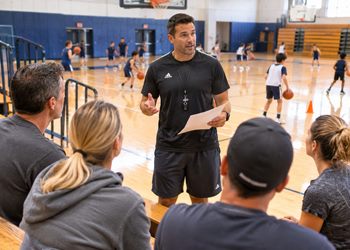
Most youth coaches dread the preseason parent meeting for two reasons: one unclear conversation about playing time or sideline yelling can derail a season, and a 45-minute lecture eats up precious first-week court time while players sit idle. You only get so many hours in the gym, and you shouldn't have to trade skill reps for team logistics.
With a tight 20-minute agenda, plain scripts for tough topics, and a parallel station plan on the court, you can walk into night one prepared, respected, and in control of the season's tone. Useful coaching help can be free, too--you can pair a simple printed handout with free BasketballXpert drills, stat sheets, and blank court diagrams so families leave aligned and ready to help.
Set the Meeting Structure Before Anyone Walks In
Winging a session creates an unchallenging environment where players do not advance. Taking time to plan ahead makes things flow smoother and keeps kids focused, as noted in BasketballXpert's guide on The Importance of Planning in Basketball Practices. The same rule applies to your parent meeting. Sessions fail without a specific goal, immediate feedback, and concentration--and Why do Basketball Practices Fail? points out that stating a clear goal up front keeps people from just going through the motions.
A 20-minute meeting will not answer every question a family has all year, but it sets a calm, respectful standard so you are not improvising in a hallway after a tough loss. Prepare a one-page printed handout before anyone walks in and hand it to parents at the door so you do not have to read dates aloud.
What to put on the one-page handout:
- Practice and game logistics: Weekly gym times, arrival expectations (shoes tied and ready 10 minutes before tip or practice start), and required gear (water bottle, reversible jersey, court shoes).
- One communication channel: Name the single app, email thread, or group text you will use for schedule changes and announcements--and state that you do not check multiple platforms.
- The 20-minute meeting agenda: Printing the four timed blocks at the top of the page signals that you respect everyone's evening.
Your 20-minute timed agenda:
- Minutes 0-2 (Welcome and Goal): Thank families for being there and state the season's focus.
- Minutes 2-10 (Standards and Scripts): Cover playing time, sideline conduct, and communication rules.
- Minutes 10-15 (Game-Day Help and At-Home Resources): Fill volunteer spots and point parents to free practice tools.
- Minutes 15-20 (Safety Protocol and Q&A): Review hydration, emergency contacts, and concussion protocol, then take quick logistics questions.
What to say in the opening two minutes:
"Thanks for getting your kids here on time. Our goal this season is simple: build fundamentals, compete with effort, and make sure every player leaves wanting to come back next year. While our players are getting real reps on the court right now, we are going to take 20 minutes--and not a minute longer--to get on the same page about playing time, sideline support, and safety."
Use Clear Scripts for the Three Hardest Parent Conversations
Mid-season friction usually starts when expectations are left unspoken on day one. As BasketballXpert contributor Shane emphasizes in Common Mistakes of a Basketball Coach, coaches must keep personal feelings, politics, and grudges off the court and make every decision based on what helps the team. Saying that out loud--backed by clear, repeatable scripts--puts everyone on steady ground before the first whistle.
Explain Playing Time, Roles, and Effort Standards
Parents rarely get upset about a box score if they understand how minutes are earned before the season starts. Define playing time around four controllable habits: attendance, hustle, coachability, and team-first play. Make it clear that mistakes are part of learning; as Shane notes in Common Mistakes of a Basketball Coach, avoid yanking players right after an error and instead use stoppages and substitutions to correct problems positively.
Teach parents what to watch for in games beyond points scored. In Beginning Coaches Should Focus on the Basics, Shane points out that youth basketball should stay simple--valuing ball possession, passing over over-dribbling, and the conditioning and footwork needed to sustain effort in the fourth quarter.
What to say about playing time and the 24-hour rule:
"Minutes are not decided by how many shots a player makes. They are earned in practice through attendance, hustle, listening to feedback, and cheering for teammates. When you watch games, look for spacing, crisp passes, and fourth-quarter hustle--not just points. If you ever have a question about your child's role, we use a 24-hour rule: wait until the next day to reach out so we can have a calm, productive conversation away from game emotions."
Set Sideline Behavior and the Chain of Communication
Sideline coaching--even when well-meaning--confuses young players who are trying to read the floor and listen to one voice. In Common Mistakes of a Basketball Coach, Shane puts it plainly: "Yelling and screaming does nothing but rattle the kids and lead to more mistakes." Ask parents to let the kids play the game and limit sideline noise to cheering effort and good team plays.
Set the standard for officials and opponents on day one, too. In Teaching Sportsmanship in Youth Basketball, Shane writes that coaches must model respect for referees, scorekeepers, and opponents--even having players shake hands with opponents before tipoff and with officials after the game regardless of the score. As Shane notes: "It only takes a firm hand once or twice and then your players and parents know improper behavior will not be tolerated."
What to say about sidelines and the chain of communication:
"From the bleachers, please cheer effort and respect the officials--let our staff handle instruction and officiating concerns. If a player has a question about their role or what they need to work on, have your player ask the coach first before practice or after a 24-hour cool-down. That builds self-advocacy, and if a parent needs to step in after that, I am always happy to talk."
How to make a calm mid-season correction: If sideline instruction creeps into early games, address it privately at the next practice or via a brief message--never in a shouting match across the gym. Say: "I appreciate how much you want to help, but when players hear two sets of instructions, they hesitate. Let's keep the bleachers focused on cheering effort so they can play free."
Keep Players Moving: Run a 20-Minute Station Blueprint During the Meeting
You do not have to sacrifice your first practice to talk to parents. If you have an assistant coach, a trusted parent helper, or an older player supervising, run a 3-station, 6-minute rotation (18 minutes of work plus 2 minutes to transition and water up) on the main court while you meet with parents in the bleachers or hallway. If you are coaching solo, run this 20-minute circuit first so players are focused and parents see your practice standard firsthand before you gather for the meeting.
Station 1: Ball-Handling Grid (6 Minutes)
Avoid putting players in lines waiting for a turn. Set up a half-court or sideline grid with cones and a basketball for every player--a setup that takes under three minutes in Basketball Dribbling and Ball Handling Basics.
- Minutes 0-3 (Basketball Ball Handling Warmup): Players dribble freely inside the grid. Blow the whistle every 20 to 30 seconds to switch tasks: right hand only, left hand only, quick change of direction, and figure-8 through the legs.
- Minutes 3-6 (The Spider Dribble): Players spread out with one ball each for stationary figure-eight dribbles through the legs and around the body, starting slowly for control before speeding up and keeping the ball low.
- Coaching cues: "Eyes up, find open space" and "Control first, then speed--do not worry about losing the ball."
Station 2: Form Shooting at the Elbow (6 Minutes)
Split the basket group into pairs or small lines at the elbows with multiple balls for faster reps, following Basketball Shooting from the Elbow.
- Setup & Rotation: Player A passes to a target at the elbow, sprints to the spot, catches, and shoots, then rebounds their own shot and rotates to the passing line. Aim for 8 to 10 clean form reps per player in six minutes rather than rushing bad shots.
- Coaching cues (from Evaluating Your Shot and Making Corrections): "Square up, use your legs, and hold your follow-through until the ball hits the rim" and "Aim for a 45-to-60-degree arc."
Station 3: Full-Court Passing to Layups (6 Minutes)
Use the opposite basket or full floor (when available) for an under-three-minute setup combining Two Line Fullcourt Passing and Layup competition.
- Minutes 0-4 (Passing to Layup): Two lines advance down the court using chest, bounce, or overhead passes and finish with a layup, then switch lines coming back.
- Minutes 4-6 (1-Minute Layup Competition): Split into two lines under opposite baskets, dribble full speed to finish layups, and count total team makes in 1 minute.
- Coaching cues: "Step into your pass, no traveling" and "Full speed to the rim, calm on the finish."
Turn Parents Into Helpful Teammates at Home and on Game Day
Most parents genuinely want to help; they just need a clear job instead of guesswork. Filling game-day roles at the preseason meeting saves you from scrambling five minutes before tipoff, and it channels parent energy into practical support without pushing paid clinics or private trainers.
Game-day volunteer roles to fill on night one:
- Scorebook and Game Clock: Ask for two regular volunteers (and one backup) to run the official book and scoreboard clock at home games.
- Team Stat Tracker: Hand a willing parent the free Printable Basketball Stats Sheet and Printable Basketball Court from BasketballXpert. On the stats sheet, helpers circle 2-point, 3-point, and free-throw attempts and mark a slash (`/`) through makes, circle offensive rebounds and slash defensive rebounds, and tally assists, steals, and blocks--while using the blank court diagram to chart shot locations.
Free at-home skill work for players who want extra touches: Share the free Beginner Basketball Drills index on BasketballXpert so families have clear court diagrams and coaching points at home. Give them two simple options from BasketballXpert that require zero expensive gear:
- Solo finishing and footwork (Some ideas for practicing on your basketball game alone): Roll the ball out for 3 seconds and sprint to finish a layup or jumper (10 reps), slide between the lane lines 6 times before finishing, or jump rope 15 minutes a day for footwork and agility.
- Two-ball control (Dribbling with Both Hands): Dribble two basketballs at the same time to build hand speed and weak-hand confidence, starting by looking down if needed and progressing to keeping eyes up.
Close With Safety Protocols and a Clear First-Week Check-In
Before you dismiss the group, spend the final five minutes on player safety. Note: The following are coach-level safety and prevention protocols, not medical advice.
- Hydration and emergency contacts: Confirm that every player brings a labeled water bottle for built-in hydration breaks, and verify that your emergency contact numbers and allergy/asthma notes are current on your roster sheet.
- Concussion recognition and removal (CDC HEADS UP): Explain that your staff follows the CDC HEADS UP 4-step Coach Action Plan. If a player takes a hit or fall and shows any observed sign (appearing dazed or confused, forgetting an assignment, balance trouble, slow answers, or mood changes) or reports symptoms (headache, dizziness, blurry vision, sensitivity to light or noise, or just not "feeling right"):
- Remove the player from play immediately ("When in doubt, sit them out")--never allow same-day return.
- Ensure evaluation by a healthcare professional experienced in concussions; coaches never judge severity themselves.
- Inform parents right away and share concussion information.
- Keep the player out until cleared in writing by an appropriate healthcare provider.
End the meeting right at the 20-minute mark with one concrete action item for every family: "Before our next practice, please confirm your emergency contact info in our team channel and bookmark the free BasketballXpert drills page if your player wants extra touches at home." You will walk back onto the court with a clear plan, aligned parents, and a team that is already moving.