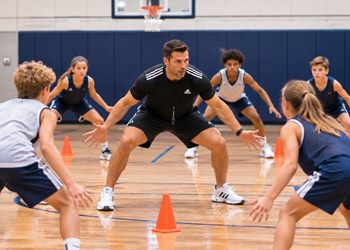
Nothing tests a youth coach's patience faster than watching beginners get beat off the dribble for three straight layups. One player swipes at the ball, another stares at the dribbler while their assignment sneaks behind them, and the whole defense collapses before the offense runs a single screen.
In that moment, it is tempting to pack everyone into a 2-3 zone just to survive Saturday's game. Man-to-man defense sticks for beginners when practice looks like the game--using whole-part-whole reps to isolate stance, positioning, and closeouts before going right back to live basketball. You do not need an hour of dry slide lines; you need two simple positioning rules, a controlled closeout habit, and a repeatable 20-minute station block.
Why Beginners Struggle With Man-to-Man (And What to Fix First)
Most beginner defensive breakdowns come from three predictable habits:
- Standing upright instead of bending at the knees and hips, which leaves defenders slow to react on the first dribble.
- Reaching with their hands instead of moving their feet. As BasketballXpert contributor Shane notes in Tips for Becoming a Better Basketball Defensive Player, "Reaching will only get you fouls or beaten off the dribble."
- Ball-watching with their back turned to their assignment, giving up easy backdoor cuts.
Hiding in a zone or running long, ball-free slide lines fixes none of those habits. A zone masks poor footwork for a season while delaying real defensive growth, and endless baseline slides without a ball handler rarely transfer to live play--they only eat up scarce gym time.
Instead, build your defensive block around whole-part-whole teaching:
- Whole: Let players compete in live 1-on-1 or small-sided play so the defensive problem shows up right away.
- Part: Isolate one habit--stance, off-ball vision, or closeouts--with a short, focused rep.
- Whole: Put them straight back into live 3-on-3 or 5-on-5 so the habit sticks under game speed.
Staying low makes a player more explosive, and keeping their head on a swivel lets them help teammates--something Tips on Better Man to Man Defense emphasizes with a simple reminder: "Do not just lock in on the ball. Being aware will allow you to help when needed." Consistent effort on defense, as The Basics of Playing Good Defense in Basketball points out, often separates a winning team from a struggling one. Effort alone will not fix bad positioning, though--players also need clear rules for where to stand.
The Two Habits Every Beginner Defender Needs First
Beginners freeze when coaches throw complex help-and-recover rotations at them before they can guard one player. Strip your teaching down to two non-negotiable habits: guarding the ball and guarding off the ball.
Ball pressure is the foundation. As Shane explains in Tips on Better Man to Man Defense, "Get pressure on the ball! It is key number one. Getting pressure on the ball limits the decision making process of the player with the ball and stops quick attacking." Pair that pressure with quick feet, active hands, and early awareness in passing lanes--habits highlighted in The Basics of Playing Good Defense in Basketball--and your team has everything it needs to compete without overthinking.
Stance, Slide, and Staying Between Player and Basket
What to teach: Show players a low, balanced athletic stance--feet wider than shoulder-width, knees bent, hips low, chest up, and weight on the balls of their feet. Hands stay up and active in the ball handler's line of sight and passing lanes, never reaching down across the body.
What to watch for: Beginners cross their feet when they hurry, lunge forward on a jab step, or swipe down at the ball. They also tend to give up the middle of the lane instead of forcing the dribbler wide toward the sideline, where the boundary acts as an extra defender.
What to say and run:
- Verbal cues: "Beat them to the spot with your chest" and "Feet first, hands up."
- Correction: When a player reaches or crosses their feet, freeze the rep for three seconds, reset their hips lower, and have them slide two steps without letting their heels click.
- Quick drills to build the habit:
- Fast Footwork Drill (2 minutes): Spread players over half the court without basketballs in a low stance (knees bent, arms up and away from the body) and have them react to your commands to shuffle left, right, or back.
- Basketball Defensive Channeling: Pair players up so a defender shuffles in front of a slow-dribbling ball handler down the court, using body positioning to force the dribbler wide without reaching for steals. Channeling teaches footwork fast, though it works best at controlled speed before you graduate players to full-speed 1-on-1.
Ball-You-Basket Positioning Off the Ball
What to teach: Every off-ball defender forms a triangle with the ball and their assignment, standing closer to the paint than the player they guard. Teach them to use "pistols"--pointing one index finger at the ball and the other index finger at their player--so they always keep both in their peripheral vision.
What to watch for: Young defenders stare straight at the ball handler and lose track of their assignment behind them, inviting easy backdoor layups. They also go silent off the ball instead of calling out cutters and screens.
What to say and run:
- Verbal cues: "See ball, see man" and "Point at both--if you cannot see both, step back toward the paint."
- Correction: Blow the whistle mid-possession and ask every off-ball defender to freeze and point. If a player has to turn their head to find their assignment, have them take two steps back toward the lane line until both targets sit in front of them.
- Why talking matters: Defensive communication--constantly sharing what you see--keeps teammates in position to help on cutters and anticipate passes, a habit stressed in The Basics of Playing Good Defense in Basketball and Tips for Becoming a Better Basketball Defensive Player. Pistols feel awkward for the first week, so expect to remind players every few possessions until their eyes adjust.
How to Teach Closeouts Without Giving Up Straight-Line Drives
The single most common game-day breakdown for beginners happens on the pass: a defender sprints out of control at a shooter and gets blown past on a straight-line drive. Teaching a controlled two-part closeout fixes that immediately.
What to teach: Break every closeout into two speeds:
- Sprint the first two-thirds of the distance to close space fast while the ball is in the air.
- Chop your feet for the final third with high hands to contest the shot, dropping your hips into a balanced defensive stance as you arrive.
What to watch for: Defenders who leave their feet on a pump fake, or who run past the offensive player's shoulder because they never chopped their steps to brake.
What to say: "Sprint, chop, hands high."
How to drill it: Keep closeout reps short--fatigue makes beginners stand upright and lunge.
- Basketball 1v1 Roll: Line A starts on the baseline just outside the lane, rolls the ball to Line B just outside the three-point line, and immediately closes out to contain the 1-on-1 drive with solid footwork.
- 1vs1 Close-Down/Box-Out: A defender under the basket passes to a shooter around the free-throw line and sprints out to close down. Once they stop flying past shooters, add the progression where the shooter can shot-fake and drive to keep the defender honest.
A 20-Minute Whole-Part-Whole Defensive Station Blueprint
You do not need a full-court lecture to install man-to-man. Split your roster into small groups of 3 to 4 players per basket at half-court or side baskets so nobody stands in long lines waiting for a turn. Set two cones on the wings and one at the top of the key at each basket.
Here is your ready-to-run 20-minute station plan:
1. Whole: 4 Minutes -- Live 1-on-1 Warm-Up
- Setup: Use the 1v1 basketball game format. The defender starts around the free-throw line against an offensive player with the ball at the top cone.
- Rotation & target: Each attacker gets two possessions before rotating to defense, focusing on containing the ball handler without fouling.
- Coach cue: "Chest to ball." Let players compete and note where they reach or lose balance.
2. Part: 8 Minutes -- 2-on-2 Closeout & "See Ball, See Man" Breakdown
- Setup: Place two offensive players at the top and wing cones, and two defenders in the paint. A coach or extra player starts with the ball at the top.
- Rotation & target: Rotate offense, defense, and the waiting spot every 3 reps so every group stays moving. On your pass to the wing, the weak-side defender drops to the paint in pistols while the ball-side defender executes a controlled closeout and guards the 2-on-2 live for two dribbles.
- Coach cues: "Sprint, chop" on the pass, and "See ball, see man" off the ball.
3. Whole: 8 Minutes -- Live 3-on-3 Man-to-Man
- Setup: Play live 3-on-3 in the half-court using Three Stop Halfcourt. Small-sided games like 3-on-3 (or 4v4 Round Robin) open up the floor and force real 1-on-1 containment and help talk because fewer defenders are crowded in the lane.
- Rotation & target: The defending group stays on defense until they earn consecutive stops--as BasketballXpert defines it, "A stop is where the offensive team fails to score on a possession."
- Coach cues: "Chest to ball" and "See ball, see man."
This 20-minute block gives beginners dozens of game-speed decisions without a single wasted minute in line. If your team has only one basket, run two groups rotating every three stops so the rest period stays brief.
What to Watch and Say During the Game
Even after a great week of practice, your beginners will still give up a few drives on Saturday. Stay committed to man-to-man anyway--switching to a zone at the first breakdown teaches players that effort is optional.
Keep your eyes on two game-day checkpoints:
- Early transition matchups: Watch whether players hustle back behind the ball and find their assignment before the ball crosses half-court. As Shane puts it in The Basics of Playing Good Defense in Basketball, "Beat your man back down the court eveytime and get in a good defensive position." Getting in front of the ball handler forces a pass back or a dribble pickup, a key principle in Defending the Basketball Fast Break.
- One-pass-away positioning: When the ball is on the wing, check that weak-side defenders step back toward the paint instead of hugging the far sideline. If one player falls asleep in transition or off the ball, the whole shell cracks--just as Basketball Defensive Transition Drill reminds coaches: "Stress that it only takes one player for a defense to break down."
From the bench, skip vague yelling like "Play defense!" and give players two calm, specific cues they recognize from practice:
- "Find your player first" on every change of possession.
- "Contain first, then contest" whenever a shooter catches on the perimeter.
Reward what you want repeated. Use a Printable Basketball Stats Sheet to track defensive rebounds, steals, blocks, and team stops alongside scoring, and celebrate the player with the most stops in the post-game huddle.
Stick with this whole-part-whole approach--using stance, off-ball triangles, and controlled closeouts inside live 20-minute reps--and you will walk into next week's practice knowing your beginners can finally stay in front of the ball and hold their shape when the game speeds up.