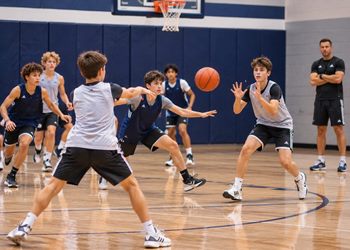
Your players look sharp tossing the ball back and forth in stationary partner lines. Then game day arrives, and passes get deflected, thrown behind cutters, or bobbled out of bounds while you yell "make a good pass" from the bench.
Turnovers pile up because practice reps rarely match game speed or defensive pressure. A skill sticks when practice looks like the game. Teach whole-part-whole: play, isolate one breakdown, then go back to live basketball. Use these four coaching cues and three game-speed drills this week to turn practice touches into cleaner ball movement and fewer turnovers.
Why Passing and Catching Break Down Under Game Pressure
Stationary partner passing creates false confidence. Players throw to standing targets with no defender in the lane, no timing to read, and no decision to make.
"The fastest way to attack in basketball is with the pass," notes Beginning Coaches Should Focus on the Basics. Every extra dribble invites a turnover, whereas a defender cannot outrun a pass--provided both passer and receiver read the same timing and space.
Practices also stall when drills lack a clear goal, immediate feedback, or player focus. As the BasketballXpert Coaching Team explains in Why do Basketball Practices Fail?, "Without concentration, the player is just going through the motions and maintaining the same flaw the basketball drill is attempting to fix or improve."
Here is the whole-part-whole fix you can run in any gym:
- Whole: Start with brief small-sided play, such as 3v3 or 4v4 half-court games in 4v4 Round Robin (first to 10 points, checking possessions outside the 3-point line), so live pressure exposes the exact turnover.
- Part: Pull the team in and isolate the one passing or catching habit that broke down.
- Whole: Go right back to live basketball so players test the fix at game speed.
Four Coaching Cues for Passing and Catching
When a pass goes wrong in practice, you do not have time to stop the gym for a three-minute lecture. BasketballXpert notes in Why do Basketball Practices Fail? that coaches must give immediate feedback so players feel the difference between a correct rep and an incorrect one and learn to self-correct.
Teaching proper chest passes, bounce passes, and outlet passes helps players move the ball up the court, break pressure, and create scoring opportunities (Basketball Passing Drills). Short external cues work best when you pair them with an immediate next rep so players feel the adjustment right away.
Passer Cues: Step to Your Target and Fake a Pass to Make a Pass
Watch your ball-handlers for flat-footed, telegraphed throws. When a player stares down one teammate and throws without moving the defender, the defense reads it before the ball leaves their hands.
- Step to your target. In the Basketball Hour Glass Passing Drill, coaches emphasize facing up and using crisp footwork to square the body to the target. On a chest pass--a quick, accurate throw from chest to chest--or a bounce pass off the floor (Five Point Passing Drill), cue players to pivot away from pressure, step toward the receiver's lead hand, and snap their thumbs down for crisp ball speed.
- Fake a pass to make a pass. In Fake Shot or Fake Pass and Take to the Hoop, the top coaching point is simple: "Sell the fake." Working on the Basketball Fast Break reinforces the same rule: "Ask for deception. Do not make it obvious where you are going to pass." If a defender's hands are high, cue a high pass fake to shift them up, then deliver a bounce pass underneath--keeping the passer balanced rather than lunging off their pivot foot.
Receiver Cues: Show a Target and Meet the Ball
Most youth passing turnovers are half-passer, half-receiver. Watch off-ball players for dropped hands at their sides and feet glued to the floor while they wait for the ball to arrive.
- Show a target. Tell receivers to put both hands up at chest or shoulder height so the passer sees an unmistakable window. Drills like Basketball Passing Drill - Pepper build soft hands and hand-eye coordination, while the Five Point Passing Drill trains quick hands and staying alert for the next play.
- Meet the ball. Never wait for a pass to drift into your chest. Step toward the flight of the ball, secure it with two hands, and stay balanced before looking to pass or drive--just as Fake Shot or Fake Pass and Take to the Hoop stresses clean ball-handling on the move before attacking. When a ball gets tipped, cue "Two hands, meet it!" instead of blaming only the thrower.
3 Passing and Catching Drills That Carry Over to Games
Passing and ball movement matter at every age and skill level to escape pressure and create scoring chances (Basketball Passing Drills). These three progressive BasketballXpert drills keep players in small groups for high touches and build from moving targets to live defenders and rim finishes.
Drill 1: Moving-Target Passing for Timing and Crisp Hands
The Five Point Passing Drill replaces static partner lines with constant movement and quick decisions.
- Setup: Split into groups of 5 with 1 basketball per group. Place 4 players in a 10-foot square and 1 player in the middle. Run for 10-15 minutes (or 4-8 minutes inside a tighter station).
- Rotation:
- The middle player passes to an outside corner and follows the pass to take that spot.
- The receiver passes to an adjacent side player and follows.
- That player passes diagonally across the square and follows, repeating a diagonal-side-diagonal pattern.
- Progression and cues: Rotate through chest passes, bounce passes, overhead passes, and longer-distance baseball passes. Call "Quick hands!" and "Follow your pass!" to coach accuracy, ball speed, and thinking one step ahead. (If you have an odd number of players for warmups, Basketball Passing Drill - Pepper lets one baseline player move down a sideline of teammates exchanging quick passes.) Because there is no live defender in Five Point, move to Drill 2 once passes are crisp.
Drill 2: Passing Against Pressure to Build Fakes and Pivots
Fake Shot or Fake Pass and Take to the Hoop adds a defender in the lane so players must catch on the move and sell a fake before attacking.
- Setup: Form a line of passers with basketballs on the left 3-point line, a line of receivers on the right 3-point line, and a coach or shadow defender at the top of the free-throw line (4-12 players, 10-15 minutes).
- Rotation:
- The receiver sprints to the block, then curls up toward the top of the key to catch the pass on the move.
- On the catch, the receiver sells a pass fake or shot fake to the left and drives right around the shadow defender to finish.
- Players switch lines after each turn.
- Progression and cues: Start with no live defense, step up to 50% defense, and finish at 100% live defense where the receiver reads the defender to shoot, pass, or sell the fake. Cue "Show a target!" on the curl and "Sell the fake!" on the catch. If passers throw early before the cutter turns, slow the rep for half a second so both players lock eyes first.
Drill 3: Pass, Cut, and Finish at Game Speed
Basketball Offensive Drill - Swing passing, cut and finish at the rim connects perimeter ball movement directly to hard cuts and layups.
- Setup: Half court with 5 players--3 perimeter players spaced around the 3-point arc and 2 baseline/post players on either side of the basket (10-15 minutes).
- Rotation:
- The coach starts the ball to a wing.
- The 3 perimeter players swing the ball around the arc while the onside baseline player slides outside and the backside post flashes to the top of the key.
- The wing feeds a post player, and the other post cuts hard to the basket for a pass and finish at the rim.
- Variations and cues: Use the cutter as a decoy to kick out for a 3-point shot, or fake the post entry to take a jump shot. Cue "Hard cut, meet the ball!" and "Step to your target!" For a full-court transition option, Full Court Passing Drill to Layup uses 3 baseline lines passing up the floor until the middle player leads a wing for a layup without traveling.
15-Minute Practice Blueprint: Whole-Part-Whole Passing Block
BasketballXpert recommends planning practices around one focused topic rather than jumping between unrelated skills (The Importance of Planning in Basketball Practices). Print this 15-minute whole-part-whole block for your next gym session:
- Minutes 0-3 (Whole -- Constrained Live Play): Run 3v3 or 4v4 half-court play using 4v4 Round Robin (first to 10 points, check outside the 3-point line). Cap each player at two dribbles per catch so passing is mandatory. Note whether turnovers come from telegraphed throws or receivers waiting on the ball.
- Minutes 3-11 (Part -- Drill Reps): Run 4 minutes of the Five Point Passing Drill in groups of 5 (target 20 clean catches per group without a drop), then 4 minutes of Fake Shot or Fake Pass and Take to the Hoop against 50% defense.
- Minutes 11-15 (Whole -- Live Scrimmage Return): Return to 4v4 half-court play with no dribble cap. Award 1 bonus point for any basket scored off a pass fake or a hard cut where the receiver met the ball.
Fifteen minutes will not cure every turnover in one night, so run this block twice a week for two weeks and track whether unforced passing turnovers drop.
What to Watch and Fix on Game Day
During your next game, watch two habits instead of chasing every bad pass:
- Passers: Do ball-handlers pivot away from pressure and fake a pass before throwing, or do they stare down one target off flat feet?
- Receivers: Do off-ball players show hands at chest height and step to meet the pass, or do they wait and let defenders jump the lane?
When a turnover happens, keep your bench calm. Yelling from the sideline rattles players and leads to more mistakes; instead, let kids play through errors, speak positively in real time, and use stoppages or substitutions to adjust (Common Mistakes of a Basketball Coach).
In a timeout, keep your message brief. As BasketballXpert advises in The Art of the Basketball Timeout, "Focus on one or two quick points and do not bombard the players with too many issues. One issue is the best and hammer your point home." Pick one cue--"Show a target and meet the ball"--say it in ten seconds, and send them back out confident.
A skill sticks when practice looks like the game. Teach whole-part-whole: play, isolate one breakdown, then go back to live basketball. Run these four cues and three drills this week, and watch your team trade sloppy game-day turnovers for crisp, confident ball movement.