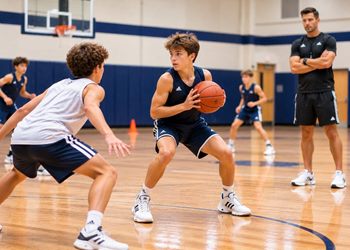
Your players travel on the catch, panic when a defender closes out, or pick up their dribble in traffic and get tied up--even after you have yelled "stop" and "pivot" all season. That breakdown rarely happens because kids do not know the rules. It happens because they practiced footwork in slow, unopposed lines instead of at game speed.
A skill sticks when practice looks like the game. When you teach whole-part-whole--let them play, isolate one breakdown, then go right back to live basketball--players build grounded confidence and calm control under pressure. Here is how to teach jump stops, pivots, and triple threat in one 15-minute practice block this week.
Why Footwork Breaks Down in Games (And What to Watch For)
In a quiet gym, almost any player can catch a pass and stop cleanly. Once a defender sprints at them, three habits trigger travel calls and rushed turnovers:
- Upright posture and a narrow base: Players catch with straight legs and feet close together, so their momentum carries them forward into an extra step.
- Dragging the pivot foot: Without a bent, balanced stance, players lean away from pressure and slide their planted foot before releasing the ball.
- Dribbles before vision: Players put the ball on the floor the instant it hits their hands, burning their dribble before they ever see a teammate or driving lane.
Top teams dedicate practice time to footwork, balance, and agility because good footwork is the foundation of the entire game--it lets players create space for a shot, beat a defender to the rim, and defend effectively. As BasketballXpert contributor Shane puts it, "Good footwork and agility enhances every aspect of a basketball player's game and skills. It is the foundation of your entire game."
The catch is that practicing movements incorrectly limits improvement and caps performance levels, while practicing them correctly speeds up learning. Static line drills without a defender let players get away with tall stances and sloppy stops, and younger players often resist footwork drills when they do not see the payoff. Explain to your team up front that better footwork and balance help them react faster, win loose balls, and get into defensive position, then use whole-part-whole so they feel that edge in live play right away.
The Two-Foot Jump Stop: Landing on Balance
A clean jump stop gives a player two options for a pivot foot and keeps their body under control when help defenders step into the lane. BasketballXpert breaks proper balance into two forms: full-court speed balance (a longer stride on the toes with the head over the torso leaning slightly forward) and control balance (a shorter step with more knee bend, playing on the toes for quick, explosive movement). As Shane notes, "Quickness comes from proper balance. It requires playing on your toes."
When you teach the two-foot jump stop, coach these checkpoints and immediate fixes:
- Simultaneous landing: Both feet hit the floor at the exact same instant. If you hear a 1-2 hop instead of a single landing, cue "hear one thud, not two."
- Wide, low base: Land with feet shoulder-width apart and hips dropped into an athletic squat so momentum stops straight down instead of forward.
- Ball tucked away: Bring the ball tightly to the chest or hip away from the nearest defender's reach--never let it hang out in front of the waist.
To build the low stance and body control behind a good stop without burning half your practice, run the Fast Footwork Drill (designed for 4-12 players over 10-15 minutes, though you can run a 3-minute burst as your "part" segment):
- Spread players across half court without basketballs. Have them drop into a low stance with knees bent and arms up, away from their body.
- Have them bounce rapidly on fast feet on the balls of their feet.
- Call quick commands--turn, shuffle, jump up, get low--and add a freeze command where they stick a silent, balanced two-foot landing.
- Cue "chest up, knees bent" and "stick it" whenever you see heels clicking or torsos tipping forward.
Once they stick the landing without the ball, pair movement with a catch using Basketball Agility work to Shooting. Players come out of quick footwork, receive a pass into a shooting zone, and gather themselves with good balance and footwork before rising into a jumper or layup--without rushing.
Pivoting and Triple Threat: Turning Control Into Options
Stopping on balance only helps if the player stays calm after the catch. The goal of pivoting and triple threat is to keep the dribble alive both mentally and physically, turning a dead stop into passing, shooting, and driving lanes.
As Shane explains on footwork and stance in 1v1 play, "You must know how to make your movement to defeat the opponent. You even want to coax your defender into making mistakes. When your defender gets off-balance proper footwork will allow you to beat them." Even great players like Tim Duncan built their game around mastering fundamentals--footwork, positioning, and stance--rather than relying on flashy moves alone.
Front and Reverse Pivots to Protect the Ball
Once a player lands on two feet, they need to know which way to turn based on where the defender is standing. Teach the difference in two sentences, then rep it:
- Front pivot (opening up): Step forward with the non-pivot foot to face the rim or a teammate when the defender gives you a cushion. Use this to square up, see the floor, and attack or pass.
- Reverse pivot (shielding pressure): Step backward with the non-pivot foot, putting your back and hip between a tight defender and the ball. Use this when a defender crowds your airspace on the catch.
Watch closely for the two mistakes that cause most youth turnovers: lifting the planted heel (which turns a pivot into a travel) and swinging the ball across the chest at waist height where defenders can slap it away. Keep your sideline cues short: "glue your pivot foot" and "chin it and sweep low"--meaning tuck the ball under the chin when turning high, or sweep it low past the shins to clear a defender's reach.
The Triple-Threat Stance and First-Second Reads
Too many youth players catch the ball, drop their eyes, and bounce it once out of nervous habit. Teach them to square up with the ball in the shooting pocket, knees bent, and eyes on the rim and the defender's lead foot before deciding to shoot, pass, or drive. Cue "catch, square, see the rim first" on every perimeter catch.
Use Faking to Create Space for Your Jumpshot to make triple threat automatic:
- Place a static defender or chair at the perimeter and have the offensive player receive a pass and square up immediately in triple threat.
- Have them sell one crisp pass fake or shot fake to move the defender off balance.
- Once the defender reacts, attack with a hard escape dribble or drive straight to the basket.
To bridge from unopposed reps into live decisions, progress to Fake Shot or Fake Pass and Take to the Hoop. Start with a shadow defender at 0% defense, move to 50% defense, and finish at 100% live defense so the ball handler reads the defender's reaction in real time to shoot, pass, or drive.
15-Minute Footwork Station Blueprint: Whole-Part-Whole in Practice
You do not need an hour of line drills to fix footwork. BasketballXpert lists its individual footwork and 1v1 drills at 10-15 minutes each for 4-12 players with under 3 minutes of setup, so in a tight 15-minute practice block you will run shorter, high-tempo station bursts at multiple baskets to keep players out of long lines.
Split your team into groups of 4-6 players across two or three baskets and run this whole-part-whole flow:
- Minutes 0-4 (Whole -- Live 1v1 Constraints): Start at each basket with the 1v1 basketball game. Each offensive player starts near the free-throw line and gets two live possessions against a defender before rotating, using fakes to create scoring space while the defender works to contain without fouling. Constraint: Every catch starts with a two-foot jump stop and a 1-second triple-threat pause before dribbling. Cue "two feet, see the rim."
- Minutes 4-9 (Part -- Isolate the Breakdown): Split into two quick stations--one focused on closeout balance and one on ball-screen/perimeter stops. At the balance station, run the Four Cone Agility Drill in a 5-10 yard square with four colored cones and mismatched colored balls; players react to a tossed ball, sprint, and use short choppy steps in a low athletic stance to close out to the matching cone. At the second basket, rep front and reverse pivots on a coach whistle with "glue your pivot foot" and "chin it and sweep low." Aim for 8-10 clean reps per player before rotating.
- Minutes 9-15 (Whole -- Game-Speed Closeouts): Finish with Basketball 1v1 Roll. Set two lines--one on the baseline outside the lane and one outside the 3-point line. The defender rolls the ball out and closes out hard while the offensive player gathers the ball on two feet, squares into triple threat, and attacks 1v1, finishing with both strong and weak hands.
Because players start in live 1v1, fix one specific habit in the middle 5 minutes, and immediately test it against a real closeout, the footwork carries straight into Saturday's game.
Game-Day Corrections That Stick Without Over-Coaching
During a game, long speeches from the sideline freeze players mid-possession and make them play scared. As BasketballXpert notes in its agility-to-shooting coaching points, short cues like "Gather yourself," "Good balance and footwork," and "Do not rush it" keep players calm without overloading their heads.
Keep your in-game corrections to two tools:
- One-word sideline triggers: Use "One thud!" when a player hops into a travel, "Glue it!" when they start to slide a pivot foot, and "See the rim!" when they catch and immediately put their head down.
- 20-second bench-huddle resets: When a player comes out after a turnover under pressure, skip the lecture. Ask them one question--"Where was the defender's lead foot?"--and remind them that better balance gives them that extra instant to track down a loose ball or beat a defender.
When practice looks like the game through whole-part-whole reps, your players do not need you to micromanage their feet from the bench. They land on two feet, protect the ball with a strong pivot, and make their next play with calm control.