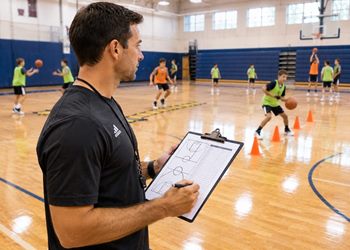
You walk into a crowded gym with 60 to 90 minutes of floor time, thirty kids bouncing basketballs, and two assistants waiting for direction. When players stand in long lines or jump straight into disorganized 5-on-5, the loudest shooters get all the touches while quiet, coachable kids blend into the background--and you leave the gym guessing who actually helps your team.
Practice gets better when the plan is already diagrammed. When you walk in with a printable setup, clear round times, short coaching cues, and a simple evaluation sheet, tryout chaos turns into calm confidence and fairness for every player on the floor.
Define Your Evaluation Rubric Before Players Step on the Court
Winging a tryout hurts both the players and your roster decisions. As BasketballXpert contributor Shane notes in The Importance of Planning in Basketball Practices, "A little planning can make your life as a basketball coach much easier and your practices flow much smoother." A rubric does not replace your coaching eye over a full season, but it gives you consistent notes when thirty kids are moving at once.
Before anyone laces up, hand each player a numbered pinnie and put your clipboard together using two printable tools:
- Print your court and stat sheets: Pair the Printable Basketball Court diagram to sketch your station spots with the Printable Basketball Stats Sheet to track tangible game actions. That stats sheet lets you mark 2-point, 3-point, and free-throw attempts (a circle) and makes (a slash `/`), alongside offensive and defensive rebounds, assists, steals, and blocks.
- Score five observable habits (1 to 4 scale): On a simple 1-to-4 rubric next to each pinnie number (1 = rarely shows it, 2 = inconsistent, 3 = reliable, 4 = sets the standard), grade what wins games rather than just who scores:
- Ball security under pressure (eyes up, protects the ball in traffic)
- Defensive stance and effort (stays low, moves feet, contests without reaching)
- Off-ball movement (cuts with purpose, spaces the floor instead of watching)
- Finishing and shooting mechanics (balanced base, clean catch, composed finish)
- Communication (calls screens, talks on help defense, encourages teammates)
Run a 32-Minute High-Touch Tryout Station Blueprint
Skill stations let you see every player handle, shoot, and defend in a tight window before fatigue or ball-hogging hides them. Set up four baskets for four 8-minute rounds with a 1-minute rotation between baskets (36 minutes total including transitions), putting 5 to 6 players in each group and aiming for 15+ reps per player at each station. If your gym only has two baskets, run two larger stations for 15 minutes each--the exact timing matters less than keeping lines short and reps high.
Station 1: Ball Handling Under Pressure -- Dribbling to Own the Circle
- Court setup: Gather the group inside the center circle (expand it with cones if needed) with one ball per player.
- Rotation and target: Run 2 minutes of on-the-move ball handling with heads up, then transition into Dribbling to Own the Circle, where players protect their own dribble while trying to knock opponents' balls out of the circle. Reset knocked-out players after 30 seconds so nobody sits out long.
- What to cue: "Stay low," "Protect the ball," and "Head up to see traffic."
- What to watch: Who keeps their eyes on the court instead of the floor, and who panics when a defender crowds their space.
Station 2: Finishing at Speed -- Layup Competition
- Court setup: Split the group into two lines under opposite side baskets (or use one basket with two wing lines if you are on a single hoop).
- Rotation and target: Run 1-minute full-speed rounds of Layup competition, where the next player under the basket rebounds and pushes full speed to the other end. Give each player 3 to 4 rounds so everyone gets at least 15 game-speed finishes.
- What to cue: "Push full speed" and "Stay composed at the rim."
- What to watch: Footwork under control, using the backboard, and whether players finish with either hand without slowing to a crawl.
Station 3: Catch-and-Shoot Form -- Elbow Shooting & 1-Minute Competition
- Court setup: Put shooters at the elbow and rebounders under the basket with two basketballs.
- Rotation and target: Start with 4 minutes of Basketball Shooting from the Elbow--pass to a target, cut to the elbow, catch, and shoot (mixing catch-and-shoot with shot-fake one-dribble reps). Finish with 4 minutes of 1-minute timed pairs using 1 Minute Shooting Competition.
- What to cue: "Catch clean, step and shoot" and "Don't rush the shot."
- What to watch: Balance before the catch, consistent release, and whether mechanics hold up when the clock is ticking.
Station 4: Defensive Closeouts & Footwork -- Channeling and 1v1 Box-Out
- Court setup: Pair players on the endline for the first 4 minutes, then move pairs to the basket and free-throw line for the final 4 minutes.
- Rotation and target: Run 4 minutes of Basketball Defensive Channeling, where a defender in a stance shuffles to force the dribbler outside and then inside down the court. Switch to 4 minutes of 1vs1 Close-Down/Box-Out: the defender under the basket passes to the offensive player at the free-throw line, sprints out to close down the shooter, and immediately boxes out on the shot.
- What to cue: "Active feet, no reaching" and "Close out under control, then find a body."
- What to watch: Who drops into a real stance, who chops their feet on the closeout instead of flying past the shooter, and who seeks contact on the box-out.
Evaluate Decision-Making in Small-Sided Games and Live Play
Drills show you mechanics; live basketball shows you whether those mechanics survive a defender. As noted in 4v4 Round Robin, games with fewer than 5 players per side open up the floor for offensive creativity and force better 1-on-1 defense because less help is available. Small-sided games will not replicate every full-court read, so pair them with a controlled 5-on-5 block at the end of tryouts.
Use 3-on-3 Small-Sided Games to Spot Spacing and Effort
Running 3-on-3 half-court games gives every player roughly twice as many touches as 5-on-5, leaving nowhere to hide. Use the 3-team rotation from 4v4 Round Robin: put three groups in different colored pinnies at one hoop, play 3-minute games to 5 points, check the ball outside the 3-point line to make it live ("hot"), and rotate the losing team off for the waiting group.
To sharpen what you are grading on offense, watch for the habits trained in Basketball Offensive Drill - Swing passing, cut and finish at the rim: do players swing the ball around the arc and make hard cuts after they pass, or do they stand and watch?
On defense, grade effort, ball pressure, and off-ball awareness from Tips on Better Man to Man Defense--as Shane puts it, "Be aware! Know what is going on around you. Do not just lock in on the ball." Call out "See ball, see man" on defense and "Chin the rebound" when players secure the glass using the inside-position habits from Defensive Rebounding Tips.
Watch Off-Ball Habits in Controlled 5-on-5 Scrimmages
Save the final 15 to 20 minutes for controlled 5-on-5 so you can see full-court stamina and communication. During this block, watch the three habits that separate winning role players from stat-chasers:
- Transition defense sprint-back: Use the whistle rule from Basketball Defensive Transition Drill--blow the whistle at random moments to make the ball handler set the ball down (simulating a turnover) and force everyone to sprint back. As Shane writes in Defending the Basketball Fast Break, "Transition defense takes effort, anticipation and intelligence." Remember that it only takes one player jogging back for transition defense to break down.
- Box-outs when a shot goes up: Look for players who locate their matchup and make contact to keep inside position rather than ball-watching, a core habit from Defensive Rebounding Tips.
- Engagement without the ball: Notice who sprints the lanes, calls out screens, and stays locked in when they have not touched the ball for three possessions.
If one dominant ball handler hijacks the scrimmage, change the constraint immediately: cap players at two or three dribbles, or require three passes before a shot. That quick rule change forces your quiet players into the action and shows you how your best scorer handles playing without the ball.
Test Coachability and Balance Roster Roles in Real Time
Talent without coachability stalls by midseason, and ten identical wing players do not make a functional team. You cannot judge a kid's full personality in one gym session, so test how players respond to feedback right on the floor.
As Shane advises in Common Basketball Coaching Mistakes, "Use stoppages and substitutions to adjust and correct problems. If you must make adjustments real time then speak in a positive manner to the kids." During a station or scrimmage stoppage, pull a player aside, give one specific, calm correction, and watch their next two reps:
- If shots are falling short or flat: Use a single fix from Evaluating Your Shot and Making Corrections--ask for "More leg drive and hold your follow-through" on short misses, "Get your arc up and shoulders upright" on flat/long misses, or "Extend the elbow all the way" on inconsistent distance.
- Watch the next two reps: Did the player nod, try the adjustment immediately, and lock in? Or did they roll their eyes and revert to old habits?
While you grade coachability, map your clipboard by roster roles instead of raw total points. Balance primary ball handlers who stay calm under pressure, wings who can space the floor and defend, and rebounders who embrace contact and sprint the floor.
Score the Sheet, Build the Roster, and Communicate Decisions Clearly
Once the gym clears, combine your 1-to-4 habit rubric with the concrete stats you tracked on your Printable Basketball Stats Sheet. Numbers alone never tell the whole story--a player with zero points might have four deflections, three box-outs, and five vocal defensive calls--so let your habit notes break ties on bubble players by asking two questions: Who gave consistent effort on defense and loose balls? and Which role does our roster still need?
As Thoughts on Becoming a Better Basketball Coach recommends, lay out your policies on tryouts, cuts, and playing time clearly so parents know what to expect before decisions go out. Follow the standard in Teaching Sportsmanship in Youth Basketball by treating every player and family with respect when you deliver the news:
- Send individual, respectful messages rather than posting a public cut list on a gym door or group chat.
- Thank the player for competing and name one genuine strength you saw on the floor.
- Give one specific skill focus (for example, keeping eyes up against ball pressure or holding a defensive stance through a closeout) so every player leaves with a clear next step.
When your tryout plan is already diagrammed and printable before you open the gym doors, you spend less time managing lines and more time watching basketball. Print your court diagram and stat sheet, set your four-station timer, and walk into tryouts ready to build a balanced, coachable team with total confidence.