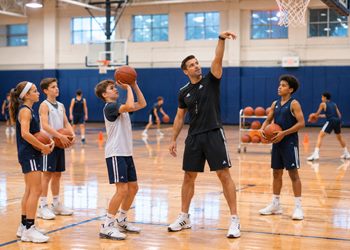
You tell your players to keep their elbow in and follow through, yet five minutes into Saturday's game they still heave the ball from their hip, push with two hands, or fade sideways. Back at practice, long single-file shooting lines eat up your gym time while kids barely get enough touches to change a habit.
Players improve from touches, not from standing in line--small groups, close-range form reps, and quick external cues fix shooting mechanics faster than long lectures. You do not need a biomechanics degree to coach this, and you will not rebuild every shot in one night. What you can do this week is walk into the gym with a clear eye for the four most common youth shooting errors, short cues that fix them on the spot, and a 15-minute high-rep station plan that carries clean form into games.
Start Close to the Rim to Build a Repeatable Base
Kids heave the ball from their hip or chest when the basket is too far away for their current strength. Starting all form work 3 to 5 feet from the rim removes the distance problem so players can build repeatable one-hand mechanics before you ever step back to the free-throw line or arc.
Have each player set their feet shoulder-width apart with the shooting foot slightly forward for balance. From there, teach the clean upper-body baseline from Evaluating Your Shot and Making Corrections:
"Set the ball on the shooting side of your head between your ear and shoulder with your shooting hand facing front and your elbow in. Shoot with your shooting arm, wrist and finger go straight toward to the basket." -- Shane, BasketballXpert contributor
Keep the guide hand resting lightly on the side of the ball--never behind it--and give kids two quick external cues they can feel right away:
- Elbow under the ball: Keeps the shooting arm aligned under the wrist instead of flaring out.
- Reach into the cookie jar: Prompts full wrist flexion and finger extension toward the rim on the follow-through.
Close-range form shooting will not add three-point range in a week, but it gives younger players the control to shoot with one hand instead of shoving the ball with two.
Spot and Fix the Four Common Youth Shooting Errors
As noted in Evaluating Your Shot and Making Corrections, "Most players just shoot though and don't evaluate their jumper." When you watch the miss pattern--short, continually long, inconsistently short or long, or missing left and right--you can separate lower-body balance problems from upper-body release errors and give the right fix immediately.
Lower-Body Errors: Narrow Stance and Sideways Drift
When a player's feet are too close together or pointed away from the rim, their upper body has to compensate mid-air. Shots that come up short usually point to not using the legs, an incomplete follow-through, or an uneven rhythm, while shots that miss left or right often happen because the player never squared up or shoved the ball from the hip instead of generating power from their legs.
Watch the player's feet at release and landing:
- Set a stable athletic base: Square the toes (or angle them slightly) at shoulder width, with a smooth dip to the shooting pocket so the legs load before the arms lift.
- Keep the head and shoulders moving forward and upward: Leaning the shoulders back sends shots continually long; teach players to finish balanced toward the rim rather than fading away.
- Use the landing cue: Call out "jump straight up, land on your footprint" so players stop drifting sideways.
If a player struggles to hold their balance under a bit of pressure, run a quick round of Two Bounce 21, which coaches players to stay in balance and keep a steady release rather than rushing off-balance heaves.
Upper-Body Errors: Two-Hand Push, Flared Elbow, and Flat Arc
Once the feet are solid, look at the guide hand, elbow, and release angle. On BasketballXpert's miss-pattern breakdown, hands positioned too far apart or a shooting arm extending on too flat a trajectory (less than 45 degrees) sends shots continually long, while incomplete elbow extension creates inconsistent short-and-long misses.
Pair each upper-body error with one direct correction:
- Two-hand push (thumb flick): Move the hands closer together on the ball, have the player pause at the top of the follow-through, and cue "guide hand stays a passenger."
- Flared "chicken-wing" elbow: Starting with the ball in front of the head and the elbow flared out causes right-handed shooters to miss right, while starting at the hip causes them to shove left. Tuck the ball between the ear and shoulder and cue "elbow in the slot."
- Flat line-drive shot: Raise the shooting arm to put a 45 to 60 degree arc on the ball and keep the arm extended until the ball reaches the basket. Cue "lift it over the front rim" to build clean backspin and arc.
Run a 15-Minute High-Rep Form Shooting Station Blueprint
Drills alone only maintain skills slightly unless coaches instruct and give immediate feedback, as Why do Basketball Practices Fail? points out. At the same time, long lines kill repetition--which is why Basketball Shooting from the Elbow emphasizes that smaller groups and multiple balls create better flow and far more reps in a 10-15 minute block:
"If it is a smaller number then multiple balls would allow for a better flow and allow greater repetitions." -- Coach Chris Johnson and the BasketballXpert Coaching Team
Use this ready-to-run 15-minute station blueprint at the start of practice:
- Court setup: Divide players into pairs or trios at 3 to 5 feet from the rim across every available basket, with one ball per two players. If you have only two baskets for 12 kids, run three pairs per hoop spaced at the blocks and front of the rim.
- Rotation: The shooter takes 5 close-range form shots, focusing on clean balance and follow-through. The partner rebounds, passes back to the shooter's pocket, and switches after 5 shots.
- Time and rep target: Run three 4-minute rounds (with 60 seconds between rounds for water and a quick reset), aiming for 25 to 30 clean makes per player across the 15 minutes.
- Between-rep coaching cues: Stand where you can see feet and elbows at once. Between turns, drop one short cue--"land on your footprint," "elbow in the slot," or "cookie jar"--and let the next rep happen.
When your players are ready to shoot from slightly farther out around the lane (15 feet or closer), plug in Little Around the World for a 10-15 minute block with a partner rebounding, keeping the focus on squaring up, setting the feet, and following through without falling away.
Bridge Form Work Into Game-Speed Catch-and-Shoot Decisions
Stationary form shooting builds the pattern, but kids will revert to two-hand heaves the moment a defender runs at them unless you bridge the gap on purpose. Use a simple whole-part-whole progression that adds movement and pressure one layer at a time:
- Add a one-step catch-and-shoot: Progress from stationary reps to catching on the move--just like Basketball Shooting from the Elbow moves from catch-and-shoot into pump fakes, jab steps, and dribble pull-ups. For an extra footwork challenge, use Basketball Agility work to Shooting so players learn to gather their balance out of movement instead of rushing.
- Introduce a controlled closeout defender: Have a partner pass and close out with one hand up at 75% speed. Watch closely: the moment speed makes a player drop the ball to their hip or push with two hands, slow the closeout down until clean form holds.
- Finish with a competitive shooting game: Run 1 Minute Shooting Competition (pairing equal-ability shooters for 1-minute rounds with the cue "catch clean, step, and shoot"), Combo Shooting for 2, or a closer-range version of Knockout! Basketball Shooting Game for younger players.
Competitive games expose rushing flaws fast--and that is the point, as long as you hold the standard:
"Don't let the players sacrifice proper technique just to get the shot off faster. Stress that rushing the shot will lead to more misses." -- Coach Chris Johnson and the BasketballXpert Coaching Team
What to Correct in Real Time--and What to Leave Alone
Trying to fix a player's feet, elbow, guide hand, and arc on the same possession only locks them up. As Why do Basketball Practices Fail? notes, "We must provide feedback so players feel the difference between a correct repetition and an incorrect repetition. They must learn the difference so they can correct and provide their own immediate feedback."
Follow a simple one-cue correction rule during practice and games:
- Fix root balance before release details: If a kid is drifting sideways or shooting off one foot, fix their base first. Upper-body tweaks will not stick on an off-balance foundation.
- Cue between reps, never mid-shot: Wait until the ball leaves their hand, then give one short, positive reminder. As Common Mistakes of a Basketball Coach emphasizes, coaches should avoid yelling or screaming because it rattles kids and leads to more mistakes--players learn by playing through errors.
- Pick one measurable habit for the week: Choose one team or individual focus--such as landing on the same footprint or holding the follow-through until the ball hits the rim--and leave minor wrist quirks alone until next week.
You do not need another complicated drill packet to help your players shoot better this season. Players improve from touches, not from standing in line--keep groups small, start close to the rim, use one short external cue at a time, and let high-rep stations turn frustrated sideline guesswork into clean, confident shots this week.