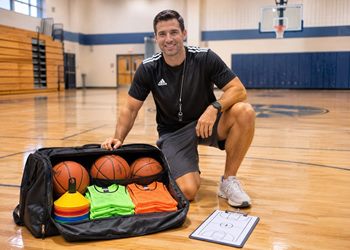
You walk into a shared 60-minute gym with 12 players, four worn-out basketballs, no cones, and no printed plan. Ten minutes later, kids are standing in long lines waiting for a turn, losing focus, and burning through the only court time you get all week.
That pre-practice scramble disappears when you pack with intention. Every piece of gear in a coach's bag should exist for one reason: keeping players moving with a basketball in their hands instead of standing in line. With a lean, budget-friendly checklist, you can walk in with prepared confidence, keep your players safe, and run a high-rep 3-station practice this week.
The Core Bag: Gear That Eliminates Standing in Line
Your primary bag does not need bulky gadgets. It needs the few tools that multiply touches per minute and cut dead time between drills in a 60-to-90-minute gym.
As noted in the Basketball Dribbling and Ball Handling Basics guide, "One mistake coaches use is to put the players in lines and have them stand around until it is their turn to go. Give everyone a ball and have everyone working at the same time."
Equipment alone does not coach the team. As Shane points out in Why do Basketball Practices Fail?, "Good coaches do not rely on just the drills to do the teaching; they instruct and offer feedback to the players." Your gear simply buys you the reps and attention you need so players can feel the difference between a sloppy rep and a sharp one.
Right-Sized Basketballs and Enough of Them
Bring at least one basketball for every two players, and aim for one ball per player during ball-handling blocks so nobody waits in line. Matching the ball to your players' hands matters just as much as ball count:
- 27.5-inch (Size 5): Best for beginners and younger elementary players.
- 28.5-inch (Size 6): Standard for girls and women ages 12 and up, and boys roughly ages 12 to 14.
- 29.5-inch (Size 7): Standard for high school boys and men ages 15 and up.
Local league rules vary slightly by division, so confirm your league's official game ball before buying a full team set.
What to watch for: If you see players launching shots from the hip, coming up short on the rim, or losing control on simple crossovers, the ball is likely too heavy or too large. Drop down a size immediately if you have one in the bag, and check their mechanics on the spot:
- Dribbling fixes: In How to Teach Dribbling in Basketball, contributor Johncd reminds coaches: "Players must control the ball with their finger tips. The last inch of fingers should be used to push the ball back to the floor. Make sure the player doesn't use the slapping motion or that they don't use their palm to dribble the basketball." Cue players to bend their knees, keep their head up, use both hands, and protect the ball with their body.
- Shooting fixes: Use the checks in Evaluating Your Shot and Making Corrections. Short shots usually come from skipping the legs, an uneven rhythm, or an incomplete follow-through. Inconsistent distance points to incomplete elbow extension. Misses to the right often happen when a player fails to square up or starts the ball in front of their head with their elbow flared out.
Cones, Pinnies, and a Whistle That Keep Flow Moving
Four small items turn a chaotic gym into an organized floor:
- 12 to 16 flat cones or poly spots: Mark grids, closeout targets, and station boundaries without tripping hazards.
- Two sets of distinct colored pinnies: Avoid matching colors so players can read teammates in a split second.
- One loud pea-less whistle: Cuts through gym echo without hurting your voice.
- One hand pump with extra needles: A flat ball sidelines a player just as fast as having too few balls.
These quantities are practical coaching targets rather than strict rules, and cutting transitions from three minutes down to 20 seconds still depends on building a routine with your players. Lock in two habits before practice starts: pre-set your cones before players arrive, and toss pinnies into players' hands right before water breaks so small-sided games start on the first whistle.
That setup lets you drop straight into high-tempo drills:
- Basketball Ball Handling Warmup: A cone grid that sets up in under three minutes where players dribble freely and switch tasks every 20 to 30 seconds on your whistle.
- Four Cone Agility Drill: Uses four colored cones in a 5-to-10-yard square to train low, choppy closeout steps.
- 4v4 Round Robin: Two sets of pinnies let you split the squad into three teams (easily scaled to 3v3) so teams rotate straight into live competition.
The Coach's Clipboard: Printed Plans, Diagrams, and Game-Day Tracking
When you wing a practice, players feel the hesitation and drift. As The Importance of Planning in Basketball Practices emphasizes, spending time beforehand to map out one or two clear goals keeps practice flowing and kids engaged.
Keep your clipboard lean and ready before you leave home:
- Printed practice plan with time blocks: List your exact minute-by-minute schedule, station pairings, and two coaching cues per block.
- Blank full-court diagrams and a dry-erase marker or pen: Stop lecturing and start showing. Print copies of the free Printable Basketball Court to sketch spacing, inbound plays, or quick timeout adjustments.
- Game-day stat sheet: Print the free Printable Basketball Stats Sheet to track 2-pointers, 3-pointers, free throws, offensive and defensive rebounds, assists, steals, and blocks--circling shot attempts and offensive rebounds, and marking a slash (/) through makes and defensive rebounds. As Johncd notes on the court diagram page, "Just print the basketball court, and start drawing up your plays. This will complement the Basketball Stats Sheet's Data with a graphical display of shots for and shots against."
If you are coaching solo with younger players, do not try to chart every column yourself. Pick two priorities--like rebounds and assists--or hand the clipboard to an assistant or reliable team parent.
Safety and Sideline Essentials Every Coach Should Pack
Note: The sideline steps below are coach-level safety preparation, not medical advice. Always follow your league's policies and defer to qualified medical professionals.
A well-packed bag protects your players when bumps and scrapes happen:
- Basic first-aid kit: Pack instant ice packs, athletic tape, bandages, and gauze for minor scrapes, jammed fingers, and rolled ankles.
- Structured water-break schedule: Build 45-second hydration stops directly into your station rotations rather than waiting until players look exhausted.
- CDC HEADS UP concussion recognition reference card: Keep a printed reference card clipped inside your bag so symptoms are never guessed from memory.
If a player takes a hard fall, collides head-to-head, or shows any possible concussion symptoms--such as dizziness, confusion, headache, or nausea--follow standard youth sports safety protocol: remove the player from play immediately, notify their parents or guardians, and keep them out of practice or games until a qualified healthcare provider evaluates and clears them. When in doubt, sit them out.
What to Leave at Home (and What to Add Only If You Have Budget)
Trunk space and team budgets disappear fast on gear that looks impressive in a catalog but stalls a 60-minute youth practice.
Leave these at home:
- Agility ladders without a ball: Footwork matters, but standing in a line waiting to hop through squares steals valuable basketball touches.
- Resistance bands that stall flow: Older varsity teams with dedicated strength blocks can put bands to good use, but in a short youth gym slot they eat up setup time.
- Heavy blocking pads: Unless you are running controlled varsity post-play, pads add bulk and slow down transitions.
Worthwhile upgrades if your budget allows:
- Collapsible ball cart: Cuts ball-pickup time at the end of practice in half and rolls straight to your car.
- Simple portable timer: Keeps station clocks honest so you never lose track of a 6-minute block.
Use one simple rule for every dollar you spend: if a tool does not add basketball touches or speed up transitions, spend that budget on extra basketballs instead.
Ready-to-Run 20-Minute Station Blueprint Using Only Your Core Bag
You can run this entire 20-minute block with nothing more than basketballs, cones, pinnies, and a whistle. Divide 12 players into three groups of four across two baskets or half-court zones (scale groups to three or five if your roster size differs). Run 6 minutes per station with 45-second water and rotation transitions on your whistle.
- Station 1 -- Ball-Handling & Protection (Open Half-Court Lane)
- Setup: Run Basketball Dribbling with Chairs using 6 to 8 cones in a straight line or zig-zag formation. Every player has a ball.
- Rep Target: 4 clean cone trips per player, switching hands cleanly at each cone.
- Verbal Cues: "Eyes up, pound the floor." Remind players to keep the ball in their outside hand, shielded from the cone "defender."
- Station 2 -- Shooting Form & Footwork (Basket 1)
- Setup: Run Two Bounce 21 - Basketball Shooting Game with 2 or 3 players per group (start younger players at the free-throw line instead of the 3-point arc; on a miss, the next shooter lets the ball bounce twice and shoots from where it lands). For a fast partner option, pair shooters in Combo Shooting for 2 for continuous catch-and-shoot reps and rebounds.
- Rep Target: 15 combined makes per pair or small group.
- Verbal Cues: "Elbow under, hold your follow-through." Keep players squared to the rim, balanced, and steady without rushing their release.
- Station 3 -- Competitive 3v3 (Basket 2)
- Setup: Toss pinnies before the rotation starts and run Three Stop Halfcourt in a 3v3 format (with a 4th player rotating in after each stop or possession). The defending team stays on defense until they earn three stops in a row--or switch to 3-minute mini-games if offense or defense stalls.
- Rep Target: One 3-stop defensive sequence or two 3-minute mini-games per 6-minute block.
- Verbal Cues: "Chop your feet, see ball, see man." Demand active hands, early help-side talk, and blocking out on every shot.
If lines start forming at any station: Add a second ball immediately, split a group of four into two pairs, or shorten the rep trigger so no player waits more than a few seconds for their next touch.
Pack your bag tonight, print your plan, and trust the setup. Every piece of gear you carry exists to keep players moving with a basketball in their hands instead of standing in line--so you can walk into your next gym with prepared confidence and coach the game.