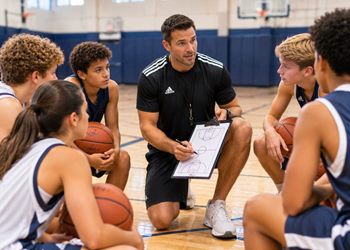
You get one or two 60-to-90-minute practices a week, a roster of kids with mixed experience, and a season that feels over before it starts. When you walk into the gym without a roadmap, it is tempting to grab three random drills off the internet or spend 40 minutes installing plays--only to watch your team make the same week-one turnovers, missed layups, and defensive breakdowns in week six.
There is a calmer way to coach. An 8-week season works when every practice block is already mapped out--with clear time splits, coaching cues, high-rep stations, and free printable BasketballXpert drills and court diagrams you can take straight to the gym. Instead of scrambling before tip-off, you walk in knowing exactly what your players need to master this week and how it connects to next month.
Why 8-Week Youth Seasons Stall (and How Two-Week Blocks Fix It)
Most youth seasons stall for one simple reason: coaches try to teach everything in every practice. According to The Importance of Planning in Basketball Practices, showing up and winging it creates an unchallenging environment where players do not advance:
"Do not do a dribbling drill followed by a shooting drill and then a defensive drill all in a row. Pick a topic and focus your session there." -- BasketballXpert
Drills alone do not teach basketball, either. As Why do Basketball Practices Fail? notes, practices stall when there is no specific goal, immediate feedback, or player concentration--without a clear target, drills barely maintain skills instead of building them. You still have to stop, instruct, and correct on the fly.
Breaking your eight weeks into four two-week blocks gives your team a steady rhythm. This four-block calendar is a practical coaching framework built around single-topic sessions, not a rigid league rule. It solves the biggest trap in youth basketball: installing too many plays before kids can dribble, pass, or stay in a stance. When a Saturday game gets messy, Common Mistakes of a Basketball Coach reminds you to stick to your system instead of panicking and throwing in five new plays on Monday.
The 4-Block Season Roadmap: What to Teach and When
Young players learn best when you build from a simple foundation and layer team concepts onto solid habits. As Beginning Coaches Should Focus on the Basics explains, "When coaching young basketball players, it is important to approach the game from a simple plot and then add the frills and skills as the players progress." Prioritizing possession, passing, conditioning, footwork, and fun early keeps kids engaged and cuts down on sloppy play later.
Everything starts with movement. The Importance of Footwork in Basketball highlights footwork and agility as the foundation for getting open shots, beating defenders, and guarding the ball. If you want to browse age-appropriate progressions as your roster grows, the Drills by Age - Beginner library organizes fundamentals by skill level so you do not jump ahead too soon.
Weeks 1-4: Ball Security, Layups, and Defensive Stance
Block 1 (Weeks 1-2): Ball Handling and Ball Protection. Teach players to control the basketball before you ask them to run an offense. In How to Teach Dribbling in Basketball, the core mechanics are simple: bent knees with butt down and a straight back, head up to see the court, comfort with both hands, and protecting the ball by keeping the body between the ball and the defender. Watch for slapping at the ball:
"Players must control the ball with their finger tips. The last inch of fingers should be used to push the ball back to the floor. Make sure the player doesn't use the slapping motion or that they don't use their palm to dribble the basketball." -- BasketballXpert
Use these two drills in Block 1:
- Dribbling with Both Hands: Line players on the baseline with two basketballs each. Have them dribble to the opposite baseline and back for 4-5 trips, resting 20 seconds between trips. Coaching cues: "Eyes up" and "Fingerpads, not palms."
- Team Dribble Tag: Put every player with a ball inside half court (or a larger grid for younger kids) with one player designated as "it." Play 60-second rounds where players protect their dribble while trying to tag others; add whistle cues to switch hands or change direction. Keep the tone encouraging--mistakes mean players are pushing their speed.
What to watch and say: When players glue their eyes to the floor or pick up their dribble in panic, call "Eyes up--see the rim" and "Chin the ball" with a wide jump stop and two-hand grip.
Block 2 (Weeks 3-4): Full-Speed Layups and On-Ball Defense. Once kids can handle the ball, connect dribbling to finishing and guarding.
- Layup competition: Split the team into two lines under the side baskets. On the whistle, players dribble full speed to the opposite basket for a right- or left-hand layup, rebound their own shot, and pass to the next teammate. Count total makes in 1 minute, then challenge the group to beat their score by 3-5 baskets on the next round. Coaching cues: "Outside hand, outside knee" and "Soft off the glass."
- Basketball Defensive Channeling: Pair players at the endline. The dribbler moves at a controlled pace while the defender shuffles in a low stance to funnel the ball handler first to the outside, then to the inside down the court. Swap roles on the return trip. Coaching cues: "Belly to the ball" and "Nose on the chest."
Alongside footwork, reinforce the five habits from The Basics of Playing Good Defense in Basketball: beat your man back in transition, keep quick hands and quick feet, anticipate passes, talk constantly, and bring steady effort. When defenders stand straight up and reach, remind them to sit in their stance and move their feet first.
Weeks 5-8: Passing Under Pressure, Spacing, and Help Defense
Block 3 (Weeks 5-6): Crisp Passing and Basic Spacing. Now that players can protect the dribble, teach them to move the ball and relocate instead of standing around watching the ball handler.
- Five Point Passing Drill: Set groups of five in a 10-foot square with one player in the middle. Players throw crisp chest and bounce passes diagonally and along the sides, following every pass to take the receiver's spot. Run 2-minute rounds, alternating pass types. Coaching cues: "Step around the defender" and "Follow your pass."
- Basketball Passing Drill - Pepper: Form one line along the baseline and a line of passers along the sideline. The baseline player jogs down the floor exchanging rapid chest, bounce, and overhead passes with each sideline passer before rotating lines. Coaching cue: "Hit the chest--no lob passes."
- Swing passing, cut and finish at the rim: Place three perimeter players around the three-point arc and two baseline players on the blocks. As the perimeter swings the ball, the ball-side baseline player slides out and the weak-side baseline player flashes to the top of the key before feeding a cutter to finish at the rim. Run 10-12 reps per group, rotating spots every two possessions. Coaching cue: "Pass, cut hard, and fill."
What to watch and say: If two players crowd the same corner or stand still after passing, freeze the drill for five seconds, point to the open spot, and say "Space to the arc" or "Cut or clear out."
Block 4 (Weeks 7-8): Help Defense, Closeouts, and Rebounding. In the final two weeks, tie team defense together. Tips on Better Man to Man Defense emphasizes pressuring the ball, denying the middle to use the sideline as an extra defender, and staying aware off the ball:
"Be aware! Know what is going on around you. Do not just lock in on the ball. Being aware will allow you to help when needed. You'll see cutters and be able to anticipate where the ball is going better." -- BasketballXpert
Pair that awareness with 1vs1 Close-Down/Box-Out: a defender passes to a shooter at the free-throw line, sprints out under control to contest the shot, and battles to box out in a low, wide stance. Run 6-8 reps per pair before rotating. As Defensive Rebounding Tips reminds players, most misses carom to the weak side and long shots produce long rebounds--"If you dont get it, then your man doesnt get it either!" Coaching cues: "See ball, see man," "High hands on the closeout," and "Chin the rebound."
A Ready-to-Run 60-Minute Practice Blueprint for Any Week
The biggest time-waster in youth basketball is standing in line. As Basketball Dribbling and Ball Handling Basics warns:
"One mistake coaches use is to put the players in lines and have them stand around until it is their turn to go. Give everyone a ball and have everyone working at the same time." -- BasketballXpert
This 60-minute whole-part-whole blueprint is a practical template built around 10-15 minute drill blocks so every kid stays moving. You can adjust the exact minutes if your gym slot is 75 or 90 minutes, and sketch your stations ahead of time on a Printable Basketball Court diagram clipped to your clipboard.
- 0:00-0:10 (10 min) -- Dynamic Ball-Handling Warm-Up (Full Court or Half-Court Grid): Every player has a ball. Run two 3-minute movement blocks (ball wraps, stationary pounds, full-court speed dribbles, or dribble tag) with a 1-minute water break. Cue: "Eyes up--work at game speed."
- 0:10-0:30 (20 min) -- Two-Station Skill Rotation (10 min per station): Split the roster into two even groups at two baskets (or one basket and one open half-court zone). Station A runs the block's offensive skill (for example, Layup Competition or Swing Passing); Station B runs the block's defensive or ball-control drill (such as Defensive Channeling or 1vs1 Close-Down/Box-Out). Aim for 20 game-speed reps per player per station before blowing the whistle to switch.
- 0:30-0:45 (15 min) -- Small-Sided Advantage Game (3v3 or 4v4): Use 4v4 Round Robin (or 3v3 if you have fewer than 12 players) on half court. The offense must check or clear the ball outside the three-point line to become live, playing to 10 points with winners staying on. As BasketballXpert notes, 4v4 gives players more space than 5v5 to read defenders and apply the week's focus. Want to isolate on-ball containment? Swap in 1v1 basketball game at the free-throw line, rotating every two possessions and awarding automatic points for fouls.
- 0:45-1:00 (15 min) -- Controlled 5-on-5 Scrimmage: Put the block's habit on the scoreboard. In Block 1, award a bonus point for zero-turnover possessions; in Block 3, require two passes before a shot; in Block 4, reward every box-out stop.
What to Watch on Game Day--and What to Change at Monday's Practice
Game day is not the time to rewrite your playbook or yank kids after one mistake. Common Mistakes of a Basketball Coach advises using stoppages and substitutions for calm, positive adjustments--then letting practice do the heavy lifting: "Use practice to develop and fine tune your system. Let the kids execute the system in the games."
Instead of watching only the scoreboard, hand an assistant or team parent the Printable Basketball Stats Sheet and a Printable Basketball Court chart. On the stats sheet, track shot attempts with a circle and makes with a slash (/), plus offensive rebounds (circle), defensive rebounds (slash), assists, steals, and blocks. Because the sheet does not have a separate turnover column, tally team turnovers in the margin so you can spot whether giveaways came from dribbling into traps or sloppy passes.
Use this simple Monday-adjustment rule: pick one breakdown from Saturday's chart and swap one 10-minute station or scrimmage constraint at Monday's practice--without throwing out your two-week block.
- High turnovers in the backcourt? Swap Station B to Defensive Channeling or add a defender to Team Dribble Tag.
- Missed layups in traffic? Run Layup Competition at Station A with a 1-minute make target.
- Giving up second-chance points? Run 1vs1 Close-Down/Box-Out at Station B and make defensive rebounds worth a bonus point in your 5-on-5 scrimmage.
How to Adapt the 8-Week Plan Without Starting Over
Real youth seasons rarely go uninterrupted. Gym nights get canceled for school events, half your roster shows up tired, and skill gaps show up fast. You do not need to scrap your plan when that happens--just adjust the load inside drills your players already know.
- When a practice gets canceled: Compress the two-week block into one sharp 60-minute session by keeping the warm-up to 8 minutes, running one core drill per station instead of two, and using your 4v4 game to reinforce the block's main habit.
- When skill levels vary widely: Keep the same drill setup and use built-in variations like those in Team Dribble Tag--require your stronger ball handlers to use only their weak hand, shrink the grid, or speed up the tempo while newer players work with both hands in a wider space. That saves you 10 minutes of explaining a brand-new drill.
- When players hit mid-season fatigue: Keep conditioning and fun front and center. As Beginning Coaches Should Focus on the Basics points out, "The frequency of turnovers rises with fatigue, creating easy baskets for the team in better shape." Shorten drill rounds to 60-90 seconds with quick water breaks so legs stay fresh.
- When you rely on volunteer assistants: Print two copies of the Printable Basketball Court diagram before you leave home, draw the two stations with cones and arrows, and hand one sheet to your assistant. Everyone knows where to stand before the first whistle.
You do not need a college playbook to run a great youth season. With four two-week blocks, a repeatable 60-minute station blueprint, and free printable BasketballXpert drills and court diagrams in your folder, you can walk into every gym calm, prepared, and focused on helping your players build habits that hold up when the clock is running.