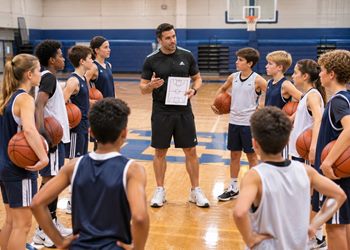
Stepping onto the court for day one with 60 minutes on the clock tests even prepared coaches. Twelve kids are bouncing balls at once, parents are watching from the bleachers, and one long line or awkward transition can drain the gym's energy in ten minutes.
You do not need a complicated playbook to run a great first practice. You need calm confidence, a clear clock, and simple cues that keep every player moving. Practice gets better when the plan is already diagrammed--so below is the exact setup, time block, and coaching cue for every minute, along with a way to print your court diagram before you walk into the gym.
Minutes 0-10: Quick Huddle, Gym Rules, and Ball-Handling Warm-Up
Skip the 10-minute opening speech. Players show up to play, not to sit in a circle while you cover every rule for the season. Spend under two minutes welcoming the team, teaching one transition rule--whistle means freeze, balls on hips, eyes on coach--and getting a basketball in every player's hands.
As BasketballXpert's Basketball Dribbling and Ball Handling Basics notes:
"One mistake coaches use is to put the players in lines and have them stand around until it is their turn to go. Give everyone a ball and have everyone working at the same time."
Run Basketball Ball Handling Warmup in a half-court grid sized for your roster so players get immediate touches without crashing into each other:
- Setup: Give every player a ball inside the half-court boundary (or full court if you have 12+ players). Start on the whistle.
- Rotation and Time: Switch dribbling tasks every 20-30 seconds for 6 minutes--right hand only, left hand only, change direction on the whistle, figure-8 through the legs, or switching balls. Keep it realistic for your age group: younger beginners may only handle single-hand dribbles and direction changes, so skip advanced moves like the spider dribble if they are still chasing loose balls.
- Finish with movement (2-3 minutes): Transition straight into Team Dribble Tag, where all players dribble inside a designated area (make it larger for younger players) while one "it" player tries to tag others.
- What to watch and say: Using the mechanics in How to Teach Dribbling in Basketball, look for knees bent, butt down, head up, and fingertip control rather than palm slapping. Encourage effort and do not punish mistakes. When you see a player staring at the floor or slapping the ball, cue: "Push the ball into the floor, chin up."
Minutes 10-35: Two-Station Skill Circuit (Passing and Layups)
The fastest way to lose a youth practice is to run one line of 12 players at a single hoop. Instead, split your team across two baskets for a 24-minute circuit: two 12-minute blocks with a 1-minute water-and-rotate break in the middle. If you only have one basket or no assistant coach, run the passing block in the half-court lane first and then move into layup lines--you lose the parallel split, but you keep the same focused clock.
As The Importance of Planning in Basketball Practices points out, setting one or two clear goals keeps a session focused, challenging, and fun before players lose attention. On day one, build around two skills that decide youth games: passing and finishing at the rim. Beginning Coaches Should Focus on the Basics emphasizes teaching passing early because the fastest way to attack is with the pass--and no defender can outrun it.
Do not let the drills run on autopilot, either. Why do Basketball Practices Fail? puts it plainly:
"Good coaches do not rely on just the drills to do the teaching; they instruct and offer feedback to the players."
Stay active in the station, give immediate feedback, and help players feel the difference between a rushed rep and a clean one.
Station 1 (12 Minutes): Moving Chest and Bounce Passes
- Setup: Pair players 12-15 feet apart along the baseline or sideline, with two pairs working per lane. If younger players cannot reach cleanly at 15 feet, start at roughly 10 feet--like the spacing used in the Five Point Passing Drill--and widen as their passes stay crisp.
- Rep Target and Progression: Aim for 25 clean catches per pair on chest passes (quick, chest-to-chest) before switching to bounce passes (bounced off the floor into the receiver's waist or chest). Once pairs hit their target cleanly, progress into Two Line Fullcourt Passing or Basketball Passing Drill - Pepper, where players pass while shuffling or moving across a lane with a focus on footwork, control, and no traveling.
- What to watch and say: Watch for passers stepping toward their target with thumbs finishing down, and receivers showing target hands. When passes float or loop softly, cue: "Step, snap thumbs down, hit the chest."
Station 2 (12 Minutes): Form Layups and Backboard Targets
- Setup: Split the group into two short lines outside the 3-point arc (right and left wing) at one basket, two balls per line. Borrow the flow from The Take It Out Warmup Drill: Line A dribbles inside the arc and passes across to Line B for a layup, and the shooter rebounds their own shot, steps out of bounds, and inbounds to the next player in Line A before switching lines.
- Rep Target: Aim for 8-10 makes per player in 12 minutes (adjust downward for younger beginners who are still learning basic footwork). If your players are older and ready for full-court pace later in the block, you can progress to Full Court Passing Drill to Layup to reinforce passing technique and avoiding traveling at speed.
- What to watch and say: Watch for outside-hand finishes, the inside knee driving up toward the rim, and eyes locked on the top corner of the backboard square. When players rush and scoop the ball from their hip, cue: "Knee up, eyes on the square, soft off the glass."
Minutes 35-50: Small-Sided Play to Connect Skills to the Game
Drills only stick when players use them in live decisions. Spend 15 minutes in 3-on-3 or 4-on-4 half-court play so players learn spacing instead of swarming the ball in a 10-player huddle.
Use 4v4 Round Robin to keep the floor moving:
- Setup: Run two half-court games if you have two baskets, or split into 3 teams (3v3 if you have fewer than 12 players) on one half court where two teams play and one rotates in. Check the ball outside the 3-point line on turnovers or rebounds.
- Time and Rules: Play to 3 baskets or 3-minute rounds. In the first round, add a 3-pass-before-a-shot rule so players look up and move the ball instead of racing straight into traffic.
- What to watch and change: Expect players to stand still right after passing--that is normal on day one. When the floor clogs up, blow the whistle for a 15-second freeze, cue "Pass and cut to open space," and restart live play immediately. If spacing completely breaks down, take 3 minutes to walk through Swing passing, cut and finish at the rim (swinging the ball around the 3-point arc and cutting to the hoop) before turning them loose again.
Minutes 50-60: Competitive Finisher, Hydration, and Closing Huddle
End day one with high energy so every player leaves excited for practice two. Choose one of two fast-paced finishers for the final 7 minutes:
- Option A -- Team Layup Countdown: Run Layup competition as a 1-minute team countdown, splitting into two lines under opposite baskets to rebound and dribble full speed for layups at the other end. Count every make across both goals, then challenge the team to add 3-5 baskets in the next 1-minute round (if they are already near their top speed, aim to beat their score by just 1-2 makes).
- Option B -- Continuous Knockout: Set up Knockout! Basketball Shooting Game from the free throw line (move closer for younger players). Because players tend to rush in Knockout and show shooting flaws, cue facing up, using the legs, and following through. Add an immediate re-entry dribble-lap rule--anyone knocked out dribbles one quick lap around the half court and jumps right back in--so nobody sits on the bench watching.
Follow the finisher with a 1-minute hydration check so players catch their breath and grab water (a simple practice-planning habit, not medical advice). Then bring everyone in for a 90-second closing huddle:
- Celebrate effort: Have players call out one teammate's hustle or good pass.
- Name one win and one focus: Share one habit the team did well today (like eyes up in the warm-up) and one focus to bring to practice two (like cutting after every pass).
When you get home, take five minutes to prep next week while day one is still fresh. Practice gets better when the plan is already diagrammed: download a free Printable Basketball Court (PDF) to sketch your station spots and tweak the clock, or grab a stat sheet and 50+ diagrammed drills from the BasketballXpert Resources page so you walk into practice two with the same calm confidence.