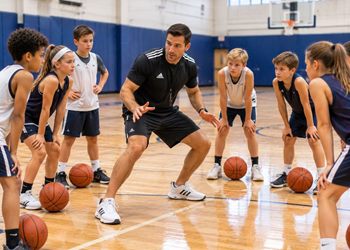
Ten minutes into practice, half your 6-to-12-year-olds are poking each other in line, bouncing balls while you talk, or staring at the bleachers. You feel like a babysitter blowing the whistle every thirty seconds instead of coaching basketball.
It does not have to feel that way. You can trade chaotic, whistle-heavy nights for a crisp, high-touch rhythm where kids stay locked in because they are always moving with a basketball. Players improve from touches, not from standing in line. Favor small groups, multiple baskets, and lots of dribbles, passes, and shots.
Make four practical shifts this week--short talk windows, tight reset routines, line-free skill games, and a timed 45-minute station blueprint--to keep your gym moving and double your players' real touches.
Why Kids Lose Focus in Practice (And What to Fix First)
Two habits kill focus faster than anything else with 6-to-12-year-olds: long coach speeches and single-file lines. As Why do Basketball Practices Fail? puts it, "Basketball practices fail to improve player's skills because there is the absence of a specific goal, immediate feedback and/or player concentration."
Standing in a ten-player line guarantees bored hands and wandering eyes. Basketball Dribbling and Ball Handling Basics warns against this exact trap: "One mistake coaches use is to put the players in lines and have them stand around until it is their turn to go. Give everyone a ball and have everyone working at the same time."
Putting a ball in every kid's hands fixes the idle time, though movement alone will not fix bad habits if players just go through the motions. You still have to tell them the one specific goal of the drill before they take their first dribble.
Fix these three things at your very next practice:
- Use one ball-parking rule: Before any demo, call "Balls on the floor, eyes on me" (or "Balls under your arm"). Wait two seconds for quiet hands before you speak.
- Cap your talk time: Name the single goal of the drill, show one clean rep, and get balls moving before kids start fidgeting.
- Measure touches, not neat lines: Judge every drill by how many dribbles, passes, or shots each player gets per minute--never by how straight the line looks.
Teach in Short Bursts and Keep Transitions Tight
Kids lose focus when a practice drags or jumps randomly from one unrelated drill to the next. A planned practice works best when it stays locked on one or two clear goals, as outlined in The Importance of Planning in Basketball Practices--when kids are challenged and enjoying the pace, they stay with you.
Fast task switches keep young brains engaged, though speed only helps when every rep still connects to your practice goal.
The 30-Second Rule and One-Cue Coaching
Long, multi-step explanations go right over a 7-year-old's head. Replace speeches with a 30-second loop: name the goal, show one rep, give one external cue--such as "eyes up" or "chin the rebound"--and blow the whistle to start.
Watch your players' eyes and hands while you talk. The moment you see wandering eyes or a stray dribble, stop talking and start the drill.
Once players are moving, coach on the fly instead of halting the whole gym. As Why do Basketball Practices Fail? explains, "We must provide feedback so players feel the difference between a correct repetition and an incorrect repetition. They must learn the difference so they can correct and provide their own immediate feedback."
Step beside one player for a two-second fix while everyone else keeps working--remind them to "Focus on vision" from Basketball Ball Handling Warmup, or to keep their eyes up and move into open space from Basketball Dribbling and Ball Handling Basics. Side-by-side coaching works for individual habits, though if half the team is running the wrong pattern, pause for ten seconds and reset the whole group.
Reset Routines That Cut Dead Time Between Drills
Most lost practice time does not happen during drills--it happens in the two or three minutes between them while you hunt for cones and herd kids back from the water fountain. Basketball Ball Handling Warmup and BasketballXpert drill cards emphasize keeping setup time under 3 minutes with simple gear like basketballs and cones.
Use two habits to cut dead time to under 20 seconds:
- Pre-place your cones: Set your station cones along the sidelines or in a grid before players walk into the gym.
- Run a whistle-and-countdown reset: Blow one sharp whistle and count out loud: "5-4-3-2-1, toes on the baseline!"
A countdown only holds its teeth if you start the next drill the instant the last player hits the line. If you wait around to lecture afterward, kids stop hustling to the mark.
Replace Lines With High-Touch Small Groups and Skill Games
Splitting a 10-to-12-player roster into groups of 3 or 4 across multiple baskets instantly multiplies touches. Turning basic fundamentals into simple skill games gives kids a clear score or rep target to chase without turning practice into a lecture.
Competitive clocks keep kids locked in, though younger players will rush their shots when a timer is running--hold them to good balance and follow-through even when they are racing the score. Try these four line-free games:
- Two Bounce 21: Put 2 or 3 players at a basket. Players shoot, chase misses after two bounces, and race to 21 points; for younger kids, start at the free-throw line instead of the 3-point arc. Cues: "Hold your follow-through" and "Stay balanced--don't rush."
- Knockout!: Give every player a ball at a side basket, moving the starting spot closer to the hoop for ages 6-8 so shots reach the rim. Cues: "Face up, use your legs" and "Follow through."
- Layup competition: Split the team into two groups at opposite side baskets and challenge them to beat a 1-minute team make target (then add 3-5 makes on the next round). Cues: "Jump off the inside foot" and "Eyes on the backboard square."
- Team Dribble Tag: Put every player inside a marked court area with a ball (use a larger box for younger players) and pick one or two taggers who also dribble. Cues: "Heads up, find open space" and "Stay under control."
Ready-to-Run 45-Minute High-Touch Station Blueprint
Run three 10-minute station rounds with 90-second water-and-rotation breaks, followed by a 10-minute whole-team skill game finisher. This 45-minute block assumes you have two hoops or one hoop plus open floor space; if you only have one basket on a half-court, run Station 3 at the hoop and place Stations 1 and 2 in opposite corners.
Station 1: Eyes-Up Ball Handling (10 Minutes)
- Floor Plan: Use Basketball Ball Handling Warmup in a coned grid with 3-4 players, each with a basketball.
- Rotation & Target: Switch tasks every 20 to 30 seconds on your whistle--right hand, left hand, change of direction, figure-8, spider dribble, or swapping balls--so kids never zone out.
- Verbal Cue: "Focus on vision--see the grid, not the ball."
Station 2: Two-Hand Chest and Bounce Passing (10 Minutes)
- Floor Plan: Run Basketball Passing Drill - Pepper in pairs or a tight 3-4 player line along the sideline or open lane.
- Rotation & Target: Players move down the line firing crisp chest passes, bounce passes, and overhead passes for 10 minutes, switching pass types every 2 minutes.
- Verbal Cue: "Step into the pass and hit their chest."
Station 3: Close-Range Form Shooting (10 Minutes)
- Floor Plan: Set 4-5 cones inside 15 feet around the lane for Little Around the World.
- Rotation & Target: Players rotate through the spots in small groups, racing a 1-minute make target or trying to finish the arc in the fewest attempts.
- Verbal Cue: "Square your feet and hold your follow-through."
Whole-Team Finisher (10 Minutes)
Wrap up with all players together in a high-energy skill game like Team Dribble Tag or Layup Competition so everyone leaves the gym sweating and smiling.
Tuning Drill Length and Accountability for 6-8 vs. 9-12
A 7-year-old and an 11-year-old do not hold focus for the same stretch, so match your clock and scoring to the kids in front of you. Age brackets are a starting point, not a rigid rule--some 8-year-olds handle longer partner games fine, while some 11-year-olds still need shorter blocks early in the season.
- Ages 6-8 (shorter blocks, individual targets): Keep blocks to 5-7 minutes and shrink the court demands. Move Knockout! closer to the hoop, start Two Bounce 21 from the free-throw line, keep Little Around the World inside 15 feet, and give players a larger box in Team Dribble Tag so they track individual make or dribble goals without traffic jams.
- Ages 9-12 (longer blocks, partner & live-read accountability): Stretch blocks to 8-10 minutes and add partner scoring or live defense. Run 1 Minute Shooting Competition with paired shooters competing for the most makes in 60 seconds, or play 1v1 basketball game, where each offensive player gets two live possessions from the free-throw line against a defender. Cues: "Attack the hoop, use a shot fake" on offense, and "Move your feet, defend without fouling" on defense.
To put your entire practice on one clipboard sheet before you walk into the gym, download the free Printable Basketball Court diagram to sketch your three stations and rotation arrows.
When you stop lecturing and start trusting small groups, short bursts, and clear targets, practice stops feeling like crowd control. You leave the gym with quiet confidence, your voice intact, and players asking when the next practice is--because players improve from touches, not from standing in line. Favor small groups, multiple baskets, and lots of dribbles, passes, and shots.