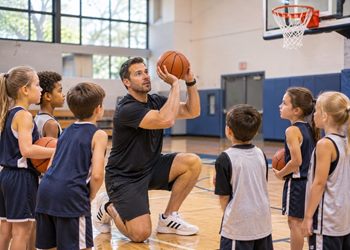
Walking into a shared rec gym on day one can feel like a guessing game. You see 7- and 8-year-olds heaving two-handed shots at a 10-foot rim with an oversized ball, and you know their shooting form is taking a hit before the season even starts.
The right drill depends on who is in the gym. Matching hoop height, ball size, and game length to your players' age band protects shooting form, ball control, and stamina--and tells you which fundamentals to train first. Use this age-by-age guide to set up your gym, adjust when rims will not budge, and run a 20-minute station plan this week.
Quick-Reference Youth Basketball Rules by Age
The table below reflects standard benchmarks from USA Basketball, NBA Youth Basketball Guidelines, and NFHS High School Rules. Local rec, YMCA, and school leagues often tweak ball sizes, quarter lengths, or pressing rules to fit shared gyms, so always check your league rulebook before tipoff.
| Age Band | Ball Size | Hoop Height | Court & Format | Game Length & Key Rules |
|---|---|---|---|---|
| Ages 5-6 (6U) | Size 3 or 4 (22-25.5 in.) | 6-8 ft | Modified open space; 3v3 or 4v4 | Focus on motor skills and fun; no strict standings |
| Ages 7-8 (8U) | Size 4 (25.5 in.; some rec leagues use Size 5 / 27.5 in.) | 8 ft (when possible) | 50x42 ft cross-court; 3v3 recommended (or 4v4/5v5) | Four 6-8 min periods; man-to-man only (no zone or full-court press); no 3-pointers |
| Ages 9-11 (10U/11U) | Size 5 (27.5 in., moving to Size 6 / 28.5 in. for older/girls tracks) | 9 ft (when possible) | 74x50 ft court; 3v3 or 5v5 | Four 8-min periods; 14-ft free-throw line; man-to-man only (no zone); no 3-pointers; limited pressing |
| Ages 12-14 (Middle School) | Size 6 (28.5 in.) for girls 12+ and many boys leagues; Size 7 (29.5 in.) later for boys | 10 ft | 94x50 ft regulation or 74x42 ft junior high; 5v5 | Zone defense and pressing permitted |
| Ages 14-18 (High School / NFHS) | Size 6 (28.5 in.) girls; Size 7 (29.5 in.) boys | 10 ft | Regulation; 5v5 | Four 8-min quarters (4-min overtime) |
Before your first game, confirm three details with your league director:
- Clock format: Whether periods use a running clock or stop clock.
- Press and zone limits: When half-court or full-court pressure is legal.
- Minimum playing time: Required substitution windows or equal-time rules.
How Ball Size and Hoop Height Shape Shooting Form and Ball Control
Equipment size is not just a rulebook detail--it dictates the mechanics your players build every time they touch the ball. When a rim is too high or a ball is too wide, young players compensate with bad habits just to reach the basket or keep a dribble alive.
In Evaluating Your Shot and Making Corrections, BasketballXpert contributor Shane sums up the starting checkpoint for clean shooting form:
"Set the ball on the shooting side of your head between your ear and shoulder with your shooting hand facing front and your elbow in."
Once set, players extend the shooting arm with a complete elbow follow-through at a 45- to 60-degree arc. For ball control, How to Teach Dribbling in Basketball notes that players need bent knees, butt down, back straight, and head up to see the court, pushing the ball with their fingertips rather than slapping it.
Spotting and Fixing Oversized-Ball Habits
When a ball is too heavy or wide for a player's hands, watch for these mechanical breakdowns during warmups:
- Hip-heaves and cross-body shoves: Setting the ball on the hip or too far to the side and shoving it across the body instead of using the legs for power.
- Flared elbows and wide hands: Placing hands too far apart so the player cannot lift the ball cleanly, or starting with the ball in front of the head with the elbow flared out--which often sends shots to the right side of the rim.
- Short shots: Coming up short because of a lack of leg drive, an incomplete follow-through, or uneven rhythm.
- Palm-slap dribbling: Slapping at the ball with flat palms instead of controlling it with the fingers.
As Dallas coach Johncd explains in How to Teach Dribbling in Basketball:
"Players must control the ball with their finger tips. The last inch of fingers should be used to push the ball back to the floor. Make sure the player doesn't use the slapping motion or that they don't use their palm to dribble the basketball."
How to fix it in practice: Switch immediately to the age-appropriate ball size if your league allows it. Then run Dribbling with Both Hands:
- Line players up on the baseline with two basketballs--one for each hand.
- Have them dribble full court while keeping their head up as their control improves.
- Cue "finger pads, eyes up" so they feel the ball with both their strong and off hands instead of slapping at it.
Adapting Practice When Your Gym Is Stuck at 10 Feet
Many volunteer coaches share school or community gyms with fixed 10-foot rims. You cannot lower the backboard, so shorten the distance and raise the arc--while keeping expectations realistic for 6- to 10-year-olds.
- Move shooting inside the paint: Run Little Around the World, which places all shooting spots around the lane at 15 feet or closer. As the drill guide notes, "In Little Around the World the shooting spots are around the lane. Shorter range with everything 15 feet or closer. This is great for younger basketball players or post players." Cue "square up, hold your follow-through" so players do not fall away on release.
- Fix flat shots with arc cues: When young players shoot flat under 45 degrees at a tall rim, tell them to raise their shooting arm higher for a 45- to 60-degree arc, keeping their head and shoulders moving forward and upward instead of leaning back.
- Prioritize layups over long jumpers: Run Layup competition by splitting players into two lines under each side basket to dribble full speed for layups. Track total team makes in 1 minute and challenge players to stay composed with clean layup form at game speed.
Managing Game Length, Clock Rules, and Substitutions
Knowing whether your league plays four 6-minute or 8-minute periods is only half the job. A running clock eats up possessions fast, while a stop clock stretches late-game fatigue--and tired kids lose their fundamentals first.
As The Primary Goals of Basketball Conditioning points out, players spend a large share of every game in a defensive stance, and late-game fatigue shows up when they can no longer stay low with hands up. Watch for standing upright on defense or lazy, telegraphed passes--those are your cues to rotate fresh legs in on the next dead ball.
Keep your bench management simple and calm:
- Sub with a purpose: In The Art of the Basketball Timeout, timeouts serve simple, practical goals: making a substitution, giving the team a rest, or stopping an opponent's run.
- Give one or two cues max: Do not bombard tired players with five corrections during a 60-second break. Pick one defensive or spacing fix and send them back out.
- Coach the stoppage, not the mistake: In Common Mistakes of a Basketball Coach, Shane advises: "Use stoppages and substitutions to adjust and correct problems. If you must make adjustments real time then speak in a positive manner to the kids." Avoid yelling from the bench or scrapping your game plan mid-quarter.
Matching Practice Drills to Your Age Group's Rules
Practices fail when drills lack a clear goal, player concentration, and immediate coach feedback so players feel the difference between a right and wrong rep (Why do Basketball Practices Fail?). As The Importance of Planning in Basketball Practices emphasizes, a quality youth practice targets one or two clear goals rather than mixing unrelated drills at random, keeping the gym fun and challenging.
Use your age group's rules to pick what to train first--and divide players into small groups across multiple baskets so nobody stands in line:
- Beginners (Ages 5-10): Ball handling, footwork, and close-range form. In Beginning Coaches Should Focus on the Basics, Shane reminds coaches: "Basketball for the younger ages is a relatively simple game. Of course it gets more advanced as the player matures. But for the beginning youth coach it is a pretty basic game and should be kept so." Teach players that the pass is the fastest way to attack rather than over-dribbling around the perimeter.
- Middle School (Ages 11-14): Passing, layups, and team defense. With 5v5 play and pressing now legal, build pace and spacing with The Basketball Three Man Weave Drill. Put groups of three on the baseline with one ball to practice crisp passing, wide lane running, teammate communication, and finishing with a layup.
- High School (Ages 14-18): Sets, help defense, and transition. At regulation 10-foot rims and full 8-minute quarters, train immediate recovery with Basketball Defensive Transition Drill. Run a 5v5 scrimmage where your whistle simulates a turnover, forcing all five players to sprint back into defensive spots immediately.
A Ready-to-Run 20-Minute Age-Matched Station Blueprint
If you have one half-court or two side baskets and 20 minutes to lock in fundamentals, run three 6-minute stations with 1 minute between rotations for water and transitions. Scale the ball size and shooting distance to your age band.
Station 1: Ball-Handling & Footwork (6 Minutes)
- Setup: Spread players in a half-court grid, each with an age-sized ball, for Basketball Ball Handling Warmup.
- Execution: Switch tasks on the whistle every 20-30 seconds (right hand only, left hand only, change of direction, figure-8s, spider dribble). Never punish dropped balls--encourage players to push their speed.
- Add-on (last 2 minutes): Drop the balls and run Fast Footwork Drill. Players hold a low stance with arms up, chopping their feet and reacting to your calls ("turn," "shuffle left," "jump," "get low").
- Verbal cues: "Eyes up" and "low stance, active hands."
Station 2: Close-Range Form & Layups (6 Minutes)
- Setup: Use lane spots at 15 feet or closer (or inside the paint if your rims are fixed at 10 feet for 8U/10U players). Pair players at a basket with one ball per pair.
- Execution: Run 1-minute shooting rounds where one player shoots 5 close-range bank shots or jumpers while the partner rebounds, then switch. Spend the final 2 minutes on full-speed layups from the wings.
- Verbal cues: "Elbow under" and "45- to 60-degree arc."
Station 3: Small-Sided 3v3 or 4v4 Live Play (6 Minutes)
- Setup: Run 4v4 Round Robin (or 3v3 for smaller rosters and 6U-8U teams) on a half-court. Split 12 players into 3 teams of 4; check possessions outside the 3-point arc and play to 10 points (or rotate every 3 minutes). As the drill guide notes: "I find 4v4 is really good because it is close to the regular game but allows more space on the court for the players to hone both offensive and defensive skills."
- Defensive focus: Apply Tips on Better Man to Man Defense by pressuring the ball, forcing dribbles wide toward the sideline, and keeping active hands in passing lanes.
- Verbal cues: "See ball, see man" and "force wide."
You do not need to guess at gym setup or watch young players struggle against oversized equipment. The right drill depends on who is in the gym--match your ball size, rim height, and clock management to your players' age band, and you will walk into practice this week ready to build clean habits from day one.