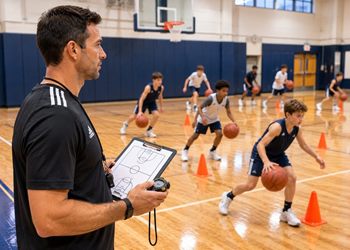
You only get 60 to 90 minutes in a shared gym, and without a time-blocked plan on paper, drills drag on, players stand in long lines, and the buzzer catches you before you ever get to defense or live game play.
Practice gets better when the plan is already diagrammed--with clear setup, time blocks, coaching cues, and a free printable layout you can take straight to the gym. Walk in with a minute-by-minute sheet on your clipboard, and you will feel confident, prepared, and in control from the opening whistle.
Why Most 60- and 90-Minute Practices Run Out of Time
The two biggest time-wasters in youth practice are long lines and slow transitions. Every extra minute kids spend waiting for a turn or jogging slowly to the sideline is a minute stolen from live basketball.
As BasketballXpert contributor Shane notes in The Importance of Planning in Basketball Practices, "A little planning can make your life as a basketball coach much easier and your practices flow much smoother." Instead of showing up to "wing it" with unrelated drills, pick one or two clear goals for the night. If defense is your theme, your ball-handling and shooting work should still reinforce defensive habits.
In Why do Basketball Practices Fail?, Shane adds: "Basketball practices fail to improve player's skills because there is the absence of a specific goal, immediate feedback and/or player concentration." Drills are just tools--tell players the goal before the whistle and give immediate feedback so they feel the difference between a sloppy rep and a sharp one.
Build every session around a simple 4-block structure (adjusting the exact split based on your roster's age and attention span):
- Warm-Up & Ball Handling (15%): Get hearts pumping and hands on the ball immediately.
- Skill Stations (30%): Keep lines to 3 or 4 players maximum, as recommended in A Basketball Practice Dribbling Session, so players get constant touches instead of standing around.
- Whole-Part-Whole Team Play (30%): Connect individual skills to 1v1, 2v2, or team concepts.
- Competitive Finisher (25%): Apply those habits at game speed with a score and a clock.
Change these three habits tonight:
- Pre-assign groups before practice. Write your 3- or 4-player station groups on your clipboard in the car--never waste gym minutes picking teams.
- Cap water breaks at 60 seconds. Give a clear time limit and blow the whistle at 50 seconds.
- Use a 10-second countdown. Count down from 10 to bring players to the next spot--if they are set before zero, start the drill immediately.
The 60-Minute Youth Practice Blueprint (Minute-by-Minute)
This 60-minute schedule works for a single-team gym slot or a half-court share. The minute blocks are tight by design--if a drill runs long, trim the next block rather than cutting live play at the end.
0-8 Minutes: Dynamic Warm-Up & Ball Handling
- Drill: Basketball Ball Handling Warmup (4-12 players, under 3 minutes to set up). While the drill can run 10-15 minutes as a standalone opener, cap it at 8 minutes in a 60-minute slot to protect your team play.
- Court Setup: Put every player inside a half-court grid with their own basketball.
- Rotation & Reps: Players dribble freely and switch tasks every 20-30 seconds on your whistle--right hand only, left hand only, change direction on the whistle, figure-8s, or swap balls with a teammate.
- Coaching Cues: "Eyes up" and "No punishment for mistakes"--encourage players to push their speed in traffic.
8-26 Minutes: Two-Station Skill Rotation
- Drill: Basketball Shooting from the Elbow (4-12 players, under 3 minutes to set up) paired with a ball-handling or passing station from the blueprint below.
- Court Setup: Line players at the wing or top with a target passer at the elbow or baseline. The shooter passes to the target, cuts to the elbow, catches, and shoots (catch-and-shoot, pump fake, or one-dribble pull-up).
- Rotation & Reps: Run two 8-minute rounds with a 2-minute transition. Aim for 15-20 game-speed shots per player per round.
- Coaching Cues: "Balance and footwork"--watch that shooters land on two feet with their shoulders squared to the rim.
26-42 Minutes: Whole-Part-Whole Team Concept
- Drill: 1vs1 Close-Down/Box-Out (2 players and 1 basketball per group) leading into your half-court defensive shell.
- Court Setup: Defender starts under the basket and passes out to the shooter at the free-throw line, then sprints to close down the shot. The shooter immediately shoots and follows while the defender boxes out.
- Rotation & Reps: Switch offense and defense after every rebound; run 6-8 reps per pair before moving into 4v4 half-court defensive rotations.
- Coaching Cues: "Low and wide," "Chin the rebound," and "See ball, see man."
42-56 Minutes: 3v3 or 4v4 Live Play with a Constraint
- Drill: 4v4 Round Robin (4-12 players, half court; play 3v3 if you have fewer than 12 players).
- Court Setup: Split into 3 teams of 4 in different colors. Two teams play while one rests; every change of possession must be cleared outside the 3-point line to become "hot."
- Rotation & Reps: Play to 10 points (2 points for 3-pointers, 1 for regular baskets, no free throws). The losing team rotates off and the resting team steps on. As BasketballXpert's drill notes explain, "4v4 is really good because it is close to the regular game but allows more space on the court for the players to hone both offensive and defensive skills."
- Coaching Cues: "Attack the gap" and "Talk on every screen."
56-60 Minutes: Competitive Finisher & Huddle
- Drill: 1 Minute Shooting Competition (4-12 players, under 3 minutes to set up).
- Court Setup: Assign players to a designated shooting spot (one ball per player or rebounder-shooter pairs).
- Rotation & Reps: Score as many baskets as possible in 1 minute, focusing on clean footwork and body control under clock pressure without rushing.
- Coaching Cue: "Clean catch, smooth release." Use the final 2 minutes to huddle and reinforce the night's single goal.
How to Scale to a 90-Minute Practice Without Losing Intensity
An extra 30 minutes is a gift only if you use it to add teaching depth and game-speed reps. Stretching a 10-minute drill to 20 minutes just drains energy--as Shane warns in The Importance of Planning in Basketball Practices, "If they are not challenged and enjoying the practice then they will lose focus and not improve on the topic you have chosen."
Add a Second Skill Block and Whole-Part-Whole Breakdown
Use 15 of your extra minutes to add a dedicated defensive or transition block in the middle of practice. Basketball Defensive Channeling is ideal here: form two even lines on the endline and send pairs full-court, with the defender shuffling to force the dribbler toward the sideline or help. Start with passive defense (no steals) so players feel the angles, then progress to live 1v1 after half-court.
Then, during live 4v4 play, pause for a 6-minute breakdown on one recurring mistake--such as late closeouts or poor spacing--before jumping right back into live possessions.
When energy dips in a longer session, watch closely to tell fatigue-driven sloppy footwork (high hips, reaching instead of sliding) apart from mental drift (standing upright, ball-watching). As Why do Basketball Practices Fail? stresses, drills alone do not teach--step in with immediate feedback and one short cue like "Stay in your stance" or "Force to the help" so players fix the habit on the next rep.
Use Small-Sided Games to Build Conditioning Inside Basketball
Skip the baseline sprints at the end of a 90-minute practice. Use the final 20 minutes for competitive small-sided games that build basketball conditioning under pressure--just remember that conditioning games only build good habits if you still enforce clean form.
- Constraint Scrimmage: Run 3v3 or 4v4 half-court with 3-minute continuous possessions (clearing outside the 3-point line on every change) or play first team to 7 defensive stops wins. Cue: "Sprint to help, talk early."
- Two Bounce 21: Run Two Bounce 21 - Basketball Shooting Game with 2-3 players per hoop. Start with a 3-pointer (or free throw for younger players): a make earns 3 points plus up to 3 free throws; on a miss, the next player lets the ball bounce twice and shoots from that spot. First to 21 wins. Cue: "Hold your follow-through."
- Knockout!: Line 4-12 players up at the free-throw line (or closer for younger players) for Knockout! Basketball Shooting Game. If a player misses, they sprint for the rebound and score before the next shooter makes theirs. Cue: "Use your legs, don't rush."
Station Rotation Blueprint for a Shared Gym (1 or 2 Baskets)
When you share a gym and only have half a court--or one main basket and a wall--stations keep everyone active. Keep groups to 3 or 4 players, as A Basketball Practice Dribbling Session advises, and run 6-to-8 minute rotation windows (18-24 minutes total).
- Station 1 -- Main Basket (1-on-1 Decision-Making): Run Basketball 1v1 Roll. Line A starts on the baseline outside the lane; Line B starts outside the 3-point line. Line A rolls the ball to Line B and closes out defensively; Line B attacks 1v1 until a score, defensive stop, or out-of-bounds. (If you have mid-court space, 1v1 basketball game also works well, giving each offensive player 2 possessions before rotating.) Rep target: 4-5 live reps per player. Cues: "Attack with your weak hand" and "Low closeout."
- Station 2 -- Sideline or Wing (Ball-Handling & Footwork): Run A Basketball Practice Dribbling Session in 2-minute timed cycles (strong hand, weak hand, through the legs, speed/direction changes) or The Spider Dribble (figure-eight around and through the legs, starting slow for accuracy before speeding up). Rep target: 3 two-minute cycles. Cues: "Keep the ball low" and "Eyes on the rim."
- Station 3 -- Opposite Sideline or Elbow (Passing): Run Basketball Passing Drill - Pepper. Set a line of players with basketballs along the sideline while one moving player slides down the line exchanging chest, bounce, and overhead passes with each teammate. Rep target: 2 full trips down the line per player. Cues: "Soft hands, step to the pass."
Where you stand: Coach from the baseline at Station 1, where you can see both the closeout and the finish. Give one quick correction per rep ("Two feet in the paint") while Stations 2 and 3 run on your whistle.
How to Diagram, Print, and Adjust Your Plan After Practice
Do not wait until you walk through the gym doors to figure out where cones and lines go. BasketballXpert's Practice Planning Basketball Drills guide recommends spending 15-25 minutes on focused skill work that progresses from high-repetition technique to game-speed decisions--with players staying low, balanced, eyes up, and talking on every possession.
Before practice, put your session onto BasketballXpert's free Printable Basketball Court diagram. As contributor Johncd explains, "Just print the basketball court, and start drawing up your plays. This will complement the Basketball Stats Sheet's Data with a graphical display of shots for and shots against." You can pair it with the Printable Basketball Stats Sheet to track shots, rebounds, and turnovers during scrimmages using simple circle and slash (/) marks.
Your clipboard routine:
- Before the gym: Diagram your 3 stations on the blank court, write your time stamps in the margin, and jot 1-2 verbal cues beside each block.
- During practice: Run straight from that one-page sheet so you never stall looking at a phone.
- 2-minute post-practice check: Before you drive home, scribble three quick answers at the bottom of the page:
- What worked right away?
- What broke down in live play?
- Which single skill opens the next practice?
Practice gets better when the plan is already diagrammed--with clear setup, time blocks, coaching cues, and a free printable layout you can take straight to the gym. Print your sheet tonight, trust the clock, and walk onto the floor confident, prepared, and in control.