Every youth coach has seen the same frustrating gap: your players look smooth dribbling in stationary warmup lines, then panic, stare at the floor, or cough up the ball the second a defender pressures them in a game. When you only have the gym for an hour, guessing which ball-handling drills fit your roster wastes precious reps.
The right drill depends on who is in the gym. Beginner work is ball handling, footwork, and form. Middle school adds passing, layups, and team defense. High school adds sets, help defense, and transition.
When you match the skill, speed, and defensive pressure to your age group, dribbling stops being a warmup routine and starts holding up on game day. Use this age-by-age dribbling progression and 20-minute station blueprint to bring clarity to your practice plan and build confident, eyes-up ball handlers this week.
Why Dribbling Breaks Down in Games (And the Habits to Fix First)
Stationary drills rarely expose bad habits because nobody is reaching, bumping, or taking away space. In a game, three flaws show up immediately: players stare at the ball, slap at it with their palms, and bounce it without a plan.
As outlined in How to Teach Dribbling in Basketball, dribbling is one of the offensive triple threats every player must learn, and every dribble needs a purpose--creating space, avoiding pressure, beating or escaping a defender, controlling pace, changing direction or the point of attack, moving the ball on offense, or driving to the basket. That guide breaks down five core mechanics to cue at every age:
- Body posture: Knees bent, butt down, back straight, bent slightly at the waist.
- Head up: Eyes scanning the court, not glued to the ball.
- Fingertips: Push the ball down with the last inch of the fingers instead of slapping with the palm.
- Both hands: Equal comfort handling the ball with either hand.
- Protect the ball: Keep your body between the ball and the defender.
"Players must control the ball with their finger tips. The last inch of fingers should be used to push the ball back to the floor. Make sure the player doesn't use the slapping motion or that they don't use their palm to dribble the basketball." -- Johncd, BasketballXpert contributor
On top of those five fundamentals, Basketball Dribbling Drills emphasizes keeping the dribble around waist height or lower and the ball in front of the body so players stay out of traps, double dribbles, and panic passes.
"Young basketball players learning to dribble should learn that they should have a purpose with every dribble." -- Johncd, BasketballXpert contributor
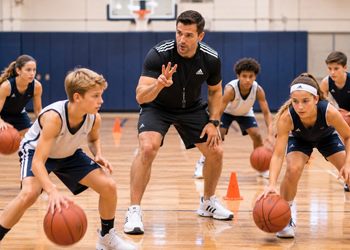
What to change in practice: Do not stop the whole gym for a lecture when a player slaps the ball or drops their chin. Flash a number with your fingers at chest height for them to call out on the move, and cue "fingertip push, chin up" in real time. Clean mechanics in warmups build the foundation, though they will still crack under pressure until you add defenders and tight spaces.
Beginner Ball Handling: Building Control and Eyes-Up Confidence
At the beginner level, your job is building basic ball control, weak-hand comfort, and the habit of keeping eyes off the floor. Teach low pound dribbles, fingertip taps, walk-to-jog control, and simple crossover and retreat dribbles before worrying about flashy combos.
The biggest trap for youth coaches is standing players in single-file lines. As Basketball Dribbling and Ball Handling Basics notes, waiting in line kills reps. Put a basketball in every player's hands inside a defined space so everyone works simultaneously--right hand only, left hand only, spider dribbles, around the waist, through the legs, and around the back--with their eyes up.
Run these three beginner-friendly drills to maximize touches:
- Basketball Ball Handling Warmup: Put every player inside a half-court grid with one ball each. Blow the whistle every 20 to 30 seconds to switch tasks--changing directions and hands, figure-8 wraps, sprinting to another ball, or knockout. Keep it fast and supportive:
"Focus on vision since there are several players in the grid. Encourage good ball skills. Encourage learning and dont punish mistakes as that is how the players learn." -- Chris Johnson and the BasketballXpert Coaching Team
- The Spider Dribble: Players spread their feet wide and dribble in a figure-eight motion through their legs and around their body. Start beginners slowly for clean hand placement before speeding up and lowering the dribble.
- Dribbling with Both Hands: Send players down and back the length of the court dribbling two basketballs at once. Beginners will naturally glance down at first, so let them find their rhythm before demanding eyes up and pushing their off hand to match their strong hand.
What to watch and say: Watch for players panicking on light contact, palming or carrying the ball, and staring at their shoes. Use short cues: "eyes on the rim," "pound the floor," and "hide the ball." Because dribbling can be practiced almost anywhere, How to Teach Dribbling in Basketball also recommends challenging young players to spend 15 to 20 minutes a day on fundamentals at home.
Middle School Progression (Ages 11-14): Dribbling With Purpose and Pressure
Once players can control the ball without staring at it, middle school practice shifts from keeping the dribble alive to beating a defender, attacking open space, and creating scoring or passing angles. Basketball Dribbling Drills narrows every dribble down to three clear purposes: penetrate (attack the rim), create passing lanes, and relieve pressure.
A simple way to bridge stationary control and live defense is Dribbling to Own the Circle. Put your team inside the center circle (expand it with cones for larger groups) and have everyone dribble on the move to force eyes-up awareness in traffic. Next, turn it into a live protection game where players shield their own ball while trying to knock opponents' balls out of the circle.
"Stay low and take care of the ball. Keep your head up to see what is going on around the court." -- Chris Johnson and the BasketballXpert Coaching Team
Attacking Space and Protecting the Ball Against Reach-Ins
Middle schoolers often dribble east-west across the court, stalling the offense, or pick up their dribble near half-court the moment a defender crowds them. Teach them to change pace with hesitations, use retreat dribbles to escape pressure, and keep their body between the defender and the ball.
- Basketball Dribbling with Chairs: Line up 6 to 8 chairs in a straight line or zig-zag formation. Players dribble past each chair as if it were a defender, keeping the ball in the outside hand away from the chair and keeping their head up to read the next chair. Chairs teach clean body-to-ball angles, though they never reach--so pair this with live pressure once the footwork is sharp.
- Dribbling in Threes: Have players advance down the court in three-dribble segments before executing crossovers, reverse-pivot spins with a hand on top of the ball, behind-the-back moves pushing off the opposite foot, or a pressure-escape sequence.
"Move down the court dribbling three with one hand, stop, take 2 dribbles back, crossover and then proceed 3 strong dribbles with the opposite hand. This simulates handling the ball against pressure." -- Chris Johnson and the BasketballXpert Coaching Team
- Basketball Dribbling Drill - Team Dribble Tag: Keep all players dribbling inside a bounded area (tighten the boundary or add a second basketball for older groups) while evading a tagger. Players learn to keep their heads up, spot open space, and accelerate under control.
Verbal cues to fix it: When you see lateral dribbling or early pickups, call out "attack the hip," "chin-to-shoulder," and "keep your dribble alive."
Connecting the Dribble to Weak-Hand Finishes and Kick-Out Passes
Middle school ball handlers also need to connect their dribble to team offense--driving into traffic to draw help and delivering a crisp kick-out pass or weak-hand layup instead of forcing a shot into a trap.
- Basketball 1v1 Roll: A baseline player rolls the ball out to an offensive player beyond the three-point line and closes out defensively. Add a wing passer to force a pass-and-cut before the 1v1 attack, and push players to drive left instead of living on their strong side.
"Players have a tendency to go to their strong hand everytime so encourage players to go left and develop skills." -- Chris Johnson and the BasketballXpert Coaching Team
- Fake Shot or Fake Pass and Take to the Hoop: Have players catch at the top of the key, sell a shot or pass fake against a shadow defender, and drive the lane to finish. Progress to 100% live defense where the ball handler reads the defender to shoot, pass, or drive.
What to correct: Stop tunnel vision on drives and jumping before deciding what to do with the ball. Run live 1-on-1 or 2-on-2 advantage games with constraints--such as weak-hand-only finishes or strict dribble caps--so players make reads while dribbling rather than after they pick it up.
High School Progression (Ages 14-18): Game-Speed Reads and Minimal Dribbles
By high school, over-dribbling kills ball movement and invites help-side traps. As Beginning Coaches Should Focus on the Basics warns, dribbling too much is one of the most common faults in the game--every extra bounce raises turnover risk, and no defender can outrun a crisp pass.
"Why do coaches allow players to dribble when they can pass so much faster? One most common faults in basketball is dribbling too much. Not only is it difficult for a ballhandler to shake a defender, the odds of a turnover increase with every bounce." -- Shane, BasketballXpert contributor
Shift your high schoolers toward attacking closeouts in one or two dribbles, escaping double-teams with a retreat-and-reverse, and reading help defenders on the move:
- Faking to Create Space for Your Jumpshot: Players catch in triple threat against a defender or chair, sell a pass or shot fake, and take one hard escape dribble to either side to rise for a clean jumper or drive to the rim.
- 1v1 basketball game: Give each offensive player two possessions from the perimeter against a defender starting at the free-throw line, forcing sharp fakes and efficient 1v1 ball handling to get into scoring range.
What to watch and correct: Call out telegraphing crossovers and aimless perimeter dribbling that freezes teammates. In scrimmages, grade possessions on dribble efficiency and decision speed--even a clean ankle-breaker is a poor rep if an open shooter was waiting on the weak-side wing.
A Ready-to-Run 20-Minute Dribbling Station Blueprint
You do not need an empty full-court gym to run high-rep ball handling. BasketballXpert's core drills in Basketball Dribbling and Ball Handling Basics take under 3 minutes to set up with just basketballs and cones, and they scale cleanly to 4-12 players or small groups of 2-6. Following A Basketball Practice Dribbling Session, cap lines at 3 or 4 players per group (add extra lines for bigger rosters) and run timed 2-minute cycles so nobody stands around.
Split your gym into three half-court skill stations (5 minutes each, using two 2-minute work cycles plus a 1-minute reset) followed by a 5-minute live whole-part-whole finisher:
- Station 1 -- Control & Eyes-Up Mechanics (5 minutes):
- Setup: Coned grid on one side of the half-court, one ball per player, groups of 3-4.
- Work: Run two 2-minute cycles covering strong hand, weak hand, through the legs, and changes of speed and direction.
- Cues: "Fingertip push," "eyes on the rim."
- Station 2 -- Pressure & Space Escape (5 minutes):
- Setup: Cones or chairs in a zig-zag lane from baseline to half-court.
- Work: Run two 2-minute cycles of 3-dribble bursts, retreat-and-cross escapes, or two-ball control for older players.
- Cues: "Attack the hip," "chin-to-shoulder."
- Station 3 -- Triple-Threat Attack & Kick-Out Read (5 minutes):
- Setup: Wing or top-of-the-key spot with a shadow or live defender and one outlet passer.
- Work: Catch in triple threat, sell a fake, attack in one or two hard dribbles, and finish weak-hand or kick out to the open wing.
- Cues: "One hard dribble," "read the help."
- Whole-Part-Whole Finisher -- Live Basketball 1v1 Roll (5 minutes):
- Setup: Baseline-to-three-point-line closeout-and-attack against live defense (or 2-on-2 advantage play for older teams).
- Work: Rotate offense-to-defense every rep; reward weak-hand drives and quick decisions before help arrives.
The right drill depends on who is in the gym--ball handling, footwork, and form for beginners; passing, layups, and team defense for middle school; sets, help defense, and transition for high school. Pick the progression that fits your roster, run this 20-minute station block at your next practice, and give your players the reps they need to handle game pressure with calm, eyes-up confidence.