You walk into a 60-minute rec or middle school practice with a clipboard in hand and one nagging question: is this drill actually right for these kids? Run complex sets with 7-year-olds and the gym turns into chaos; run static line drills with 13-year-olds and they tune out before the first water break.
The right drill depends on who is in the gym. When you match your skill priorities, verbal cues, and corrections to the age group in front of you, guesswork disappears and every rep builds habits players can use on game day.
Ages 5-7: Ball Familiarity, Footwork, and Shooting Form
At this stage, kids are still learning how their hands and feet work together, so the goal is basic coordination, two-foot stops, and early shooting mechanics. BasketballXpert's Beginner Fundamentals pathway (grouped under ages 6-10) focuses on athletic stance, dribbling with both hands, jump stops, pivots, and close-range form using a smaller ball and lower rim. If you are coaching 5-year-olds, scale the target down even further so mechanics stay intact.
What to watch for in practice:
- Slapping the ball with flat palms instead of pushing it with the fingertips.
- Traveling on stops because players try to stop on one foot while running full speed.
- Two-handed heave shots launched from too far out, which wreck form before it ever starts.
What to say and change immediately:
- Use short, repeatable cues: "fingerpads," "jump stop, two feet," and "elbow under the ball."
- Move shooters closer or lower the hoop the moment you see a two-handed heave. In Evaluating Your Shot and Making Corrections, Shane notes that short shots usually come from skipping the legs, cutting off the follow-through, or an uneven rhythm, while flat trajectories under 45 degrees sail long.
- Ditch standing lines. As BasketballXpert's Basketball Dribbling and Ball Handling Basics playbook puts it: "One mistake coaches use is to put the players in lines and have them stand around until it is their turn to go. Give everyone a ball and have everyone working at the same time."
Ready-to-run drill: Basketball Ball Handling Warmup
- Setup: Every player stands in a marked half-court grid with their own basketball.
- Rotation & timing: Switch tasks every 30 seconds on your whistle--right-hand only, left-hand only, figure-8 through the legs, spider dribble, or a quick round of Team Dribble Tag in a wide area.
- Cues: "Knees bent, butt down" and "fingerpads, not palms." As Johncd explains in How to Teach Dribbling in Basketball, players should push the ball with the last inch of their fingers rather than slapping it.
Pair that warmup with Little Around the World for shooting. Place spots around the lane at 15 feet or closer (even closer for 5- and 6-year-olds) and have players land on a two-foot jump stop before shooting. Footwork is the foundation of getting space for a shot, as Shane highlights in The Importance of Footwork in Basketball.
Ages 8-10: Weak-Hand Dribbling, Passing, and Layup Mechanics
Players in this band are ready to move from solo ball control to two-handed capability and clean finishes in traffic. They are still covered under BasketballXpert's Beginner Basketball Drills directory, which includes weak-hand dribbling, passing, and layup work. Shift them out of stationary spots and into moving pairs as soon as they can dribble without staring at the floor.
What to watch for in games:
- Eyes glued to the floor when dribbling with the weak hand, missing open teammates upcourt.
- Soft, telegraphed lob passes that defenders pick off easily.
- Jumping off the wrong foot on layups, leading to awkward, off-balance attempts.
What to say and adjust on the fly:
- Step in with "eyes on the rim," "step into your pass," and "inside knee up."
- Force weak-hand reps in movement rather than standing still. In Dribbling with Both Hands, players dribble two balls down and back from the baseline, progressing from looking down to keeping their head up so the off-hand becomes as reliable as the dominant hand.
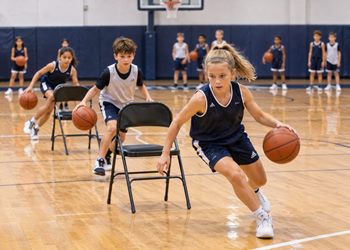
Ready-to-run drill: Basketball Dribbling with Chairs into Full Court Passing Drill to Layup
- Setup: Line up 6-8 chairs in a zig-zag down the floor for ball handling, then transition to three full-court lanes (middle and two wings) for passing and finishing.
- Rotation & target: Players weave past each chair keeping the ball in the outside hand, then run 3-player full-court waves--middle-to-wing-to-middle-to-other-wing--leading the wing into a layup at the far free-throw line. Finish with a 1-minute Layup competition at opposite side baskets to hit a team make target.
- Cues: "Protect with the outside hand" and "head up, see the court." For pure passing reps without a hoop, run the Five Point Passing Drill with four players on a 10-foot square and one in the middle, following every pass to the receiver's spot.
Ages 11-12: Spacing, Team Defense, and Finishing Under Pressure
This is the age where you break the five-player swarm around the ball and turn individual skills into real team play. BasketballXpert's Middle School / Jr High Basketball Drills (ages 11-14) target passing under pressure, weak-hand finishing, man-to-man defense, boxing out, and simple motion concepts.
What to spot in games:
- Two teammates standing within five feet of each other, bringing two defenders to the ball.
- Defenders losing their man the moment the ball swings to the opposite wing.
- Rushed, off-balance layups when a defender bumps the driver in the lane.
What to say and how to fix it:
- Repeat "see ball, see man," "fill the open spot," and "chin the rebound."
- Teach defenders to stay connected without ball-watching. As Shane writes in Tips on Better Man to Man Defense: "Be aware! Know what is going on around you. Do not just lock in on the ball. Being aware will allow you to help when needed. You'll see cutters and be able to anticipate where the ball is going better."
- Use whole-part-whole 3-on-3 segments to clean up 4-out or 5-out spacing before jumping back into 5-on-5.
Ready-to-run drill: 4v4 Round Robin (or 3v3)
- Setup: Split into 3 teams of 4 (or 3v3 if you have fewer than 12 players) on one half-court. Every change of possession must be cleared outside the 3-point line.
- Rotation & target: Play short games to 3 or 5 points; winners stay or rotate every 3 minutes. Fewer players on the floor creates natural space for cutting and exposes 1v1 defense with less help.
- Cues: "Fill the open spot" and "attack left." To layer in structured off-ball movement, run Basketball Offensive Drill - Swing passing, cut and finish at the rim with 3 perimeter players and 2 baseline relocators. For physicality, pair Basketball 1v1 Roll (forcing weak-hand drives) with 1vs1 Close-Down/Box-Out so players finish low, wide, and explosive on the glass.
Ages 13-14: Reading Defenders, Shell Defense, and Transition Decisions
Incoming high school players need to read what the defense gives them rather than memorizing a rigid script. BasketballXpert bridges the Intermediate and High School (ages 14-18) divisions here, adding ball screens, help-side rotations, and transition offense.
What to look for in games:
- Ball-watching on help rotations, leaving shooters open on the weak-side skip pass.
- Driving blindly into set help instead of hitting the roller or kicking out.
- Jogging back after a shot or turnover, giving up easy run-outs.
What to say and constrain in live play:
- Use sharp cues: "close out under control--chop your feet," "talk early on switches," and "sprint the wide lanes."
- Add live decision rules to your drills so players read the defender in front of them. In the Pick And Roll Drill, have the ball handler rub shoulders with the screener to eliminate space--if the defender goes under, shoot or slip to the open free-throw space; if they hedge, hit the roller.
- Pair on-ball containment from Basketball Defensive Channeling (forcing the dribbler wide and back inside full court) with help-side awareness so defenders learn to protect the middle together.
Ready-to-run drill: Working on the Basketball Fast Break + Basketball Defensive Transition Drill
- Setup: Three offensive lines start on one baseline against two defenders at the far end (3-on-2).
- Rotation & timing: Once the 3-on-2 finishes, the shooter or player who turned it over sprints back as the lone defender while the two original defenders attack 2-on-1 the other way. Mix in 5v5 Defensive Transition segments where a whistle forces the ball handler to set the ball down like a live turnover, triggering an instant sprint to defense.
- Cues: "Sprint the wide lanes" on offense and "find ball, protect paint" on the whistle.
A Ready-to-Run 40-Minute Station Blueprint for Any Gym
Even the best drills fall flat if players spend half the hour standing in line. As Shane warns in Why do Basketball Practices Fail?: "Basketball practices fail to improve player's skills because there is the absence of a specific goal, immediate feedback and/or player concentration." Pick one or two clear goals before you step on the hardwood--as outlined in The Importance of Planning in Basketball Practices--and run a station block where every kid stays moving.
Your exact gym layout and roster size will dictate whistle times, so treat this 40-minute template as a flexible starting structure rather than a rigid script:
- Set up 4 zones (3-4 players per group): Use two main baskets and two half-court side zones (or four baskets if your gym has them) so nobody waits for a turn.
- Run four 8-minute stations (32 minutes total, with 1-minute water/transition breaks):
- Station 1 -- Ball Handling & Footwork: Target 20 clean moves per hand before switching. Cue: "Eyes up, fingerpads."
- Station 2 -- Finishing / Layups: Target 12 made layups per group in 2 minutes. Cue: "Inside knee up."
- Station 3 -- Passing & Spacing: Target 15 crisp chest or bounce passes without a drop. Cue: "Step into your pass."
- Station 4 -- Defense & Rebounding: Target 3 consecutive stops or box-outs. Cue: "See ball, see man."
- Close with an 8-minute whole-part-whole scrimmage: Play 3-on-3 or 5-on-5 using the exact rule you just drilled--for example, no dribbling until you swing the ball once, or an automatic turnover if nobody boxes out.
You can plug age-matched drills straight into each station from BasketballXpert's Drills by Age hub--choosing Beginner for ages 5-10, Middle School / Jr High for ages 11-12, or High School for incoming 13-14-year-olds. The right drill depends on who is in the gym--pick the plan that fits your roster tonight, keep your cues short, and let your players walk out better than they walked in.